Euro Car Parts. I built Fit it for me — book-a-fitting in the basket.
Eurocarparts, one of the biggest UK distributors of car parts and accessories, with around 200 locations in Europe.
Create a journey for ‘Fit it for me’ service and seamless integration with the current basket — without changing the current flow and conversion.
ResultsOutcomes
What the work delivered, in plain terms — the service is real and still live.
The fitting service was designed inside the existing basket flow — no new app, no separate product.
Mapped and designed — postcode gates, VRM lookups, compulsory-vs-optional parts.
Principle prototypes tested with real car owners before any visual design.
Still live in 2026 — six years in production.
Blink · the whole case in seven bulletsIf you only have 40 seconds
- 2019 — Research, UX and Visual Design at Big Light for Euro Car Parts, building “Fit it for me”: book a local workshop to fit your part, straight from the basket.
- The brief: add a buy-and-install service that piggybacks the existing e-commerce basket without changing the flow or hurting conversion.
- 3 months, 4 client workshops, 1 testing session with 10 car owners — grayscale wireframes and Principle prototypes to test real interactions.
- Solved the hard data gates: an eligibility upsell (“Fit it for me from £59 nearby”), a Postcode + VRM gate (regional labour rates, multiple household cars) and clear Now-vs-Later pricing.
- Modelled part interdependencies — e.g. brake pads vs discs — guiding compulsory vs nice-to-have add-ons and correcting mismatches inline (a 4L oil kit for a 5L engine).
- Designed workshop selection (“Recommended” = proximity + facilities), two ways to book a date/time, mixed-basket tabs (Collect / Deliver / Fit it for me) and a fixed price drawer.
- Mobile-first (70% of traffic) on a modular Sketch system; shipped Midlands-beta then nationwide — a real revenue channel: £1M+ and 21,000 jobs for independent garages.
Glance · 01Fitting, booked from the basket
Euro Car Parts — a major UK parts distributor with ~200 locations — wanted a “buy and install” service. Where competitors built a separate product, we made “Fit it for me” piggyback the existing basket: buy a part online, pick a local approved workshop, book a slot and pay only for the part — all without disrupting the current checkout or conversion.
Glance · 02Process & testing
Over 3 months with the ECP team on-site two days a week, I ran 4 client workshops to absorb the business, sketched and validated the happy path with the tech team, and built grayscale wireframes to focus on function. Prototyping in Principle let me show live behaviour — like fitting prices adapting to basket items — and 10 car owners tested two hypotheses on-site.
Glance · 03The data gates
Testing showed people want to know upfront if a part is eligible to be fitted — ideally with a quote to upsell. But quotes need a postcode (regional hourly rates) and a vehicle registration, so I designed a single Postcode & VRM gate that verifies before the journey continues, pre-populating from basket data and handling households with multiple cars.
Glance · 04Parts that depend on each other
Cars rarely need one part in isolation. Using disc brakes as the model, I designed flows for compulsory vs nice-to-have add-ons — you can change pads without discs, but never discs without pads — and inline corrections when the system spots a mismatch (a 4L oil kit for a 5L engine), always leaving an escape route for users with spares.
Glance · 05Booking, baskets & outcome
Workshops were ordered by a “Recommended” mix of proximity and facilities (no ratings in phase 1), bookable by filtering results or picking a slot on the workshop page. Mixed baskets split into Collect / Deliver / Fit-it-for-me tabs, and a fixed price drawer kept the total in view. After beta, “Fit it for me” rolled out nationwide and became a genuine revenue channel for the independent aftermarket.
OverviewAbout Eurocarparts
Eurocarparts, one of the biggest UK distributors of car parts and accessories, with around 200 locations in Europe.
Aside from their existing delivery and click & collect services, there is an ongoing need for a new “Buy and install” package service. Under a series of customer requests and competition analysis, they’ve decided to create the “Fit it for me” business by offering fitting quote prices right from the shopping basket (mobile & web).
This service allows you to buy car parts online and then choose a local approved workshop to fit it. The online service allows you to choose from your closest car workshop or from the workshop labour prices to fit your selected part. After choosing the garage workshop and time, you will then only pay for the part you have ordered online.
01 — BriefThe Goal
Create a journey for ‘Fit it for me’ service and seamless integration with the current basket.
Make a seamless basket integration with the current experience, without changing the current flow and conversion.
As other competitors created a different product, with a different name and platform, we aimed to have the flows piggybacking the current ecomm journey of the main website.
The concept gives an option to users to get their parts fitted directly from the basket page, up-sell the fitting price, option select and deselect parts while reviewing the total price, select the closest workshop to user’s postcode and book a time slot.
02 — TeamTeam Structure
We were pleased to work really closely with the ECP team; they were so nice to come 2 days per week to Biglight’s offices and be with us across the lifespan of the project. This helped us shorten the feedback loop and get a good understanding of the tech and business needs.
03 — PlanRoadmap
- Define Audience & User Personas
- Research & competitor analysis
- Main User flow, validate with the tech team
- Define the happy path (wireframes)
- Tackle edge cases
- Visual Design (via DS)
04 — MethodProcess
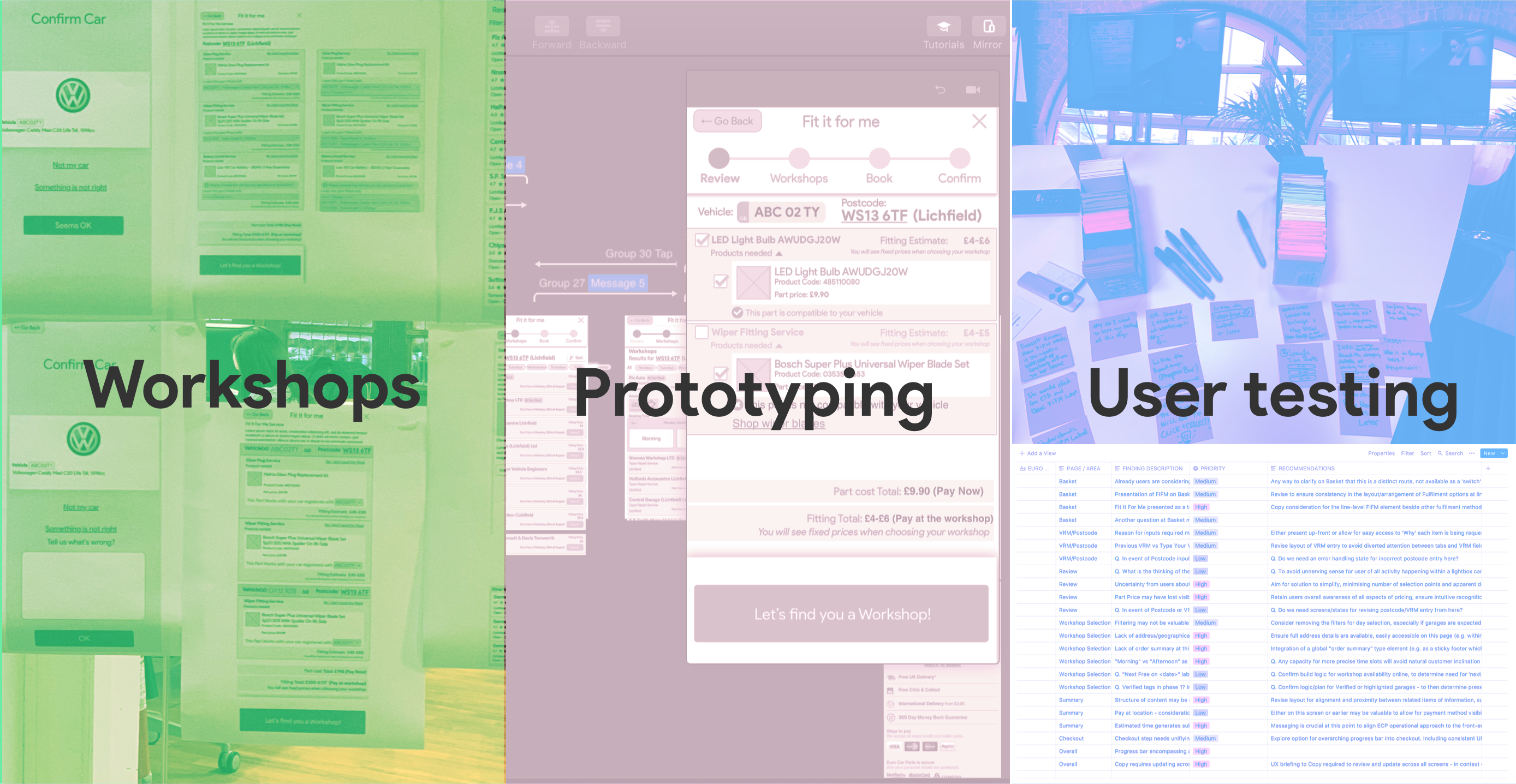
Workshops
The first thing was to understand as much as possible the nature of the business. My aim was to absorb any bit of information, to try to put myself in everyone’s shoes and see the different perspectives and understand their goals.
So I lined up some of the key people from Eurocarparts: a business executive, their logistic director and head of product design. From our agency side, we grouped our main researcher, visual designer, project manager and client account manager.
Design
In order to speed up the whole process we decided to create unbranded grayscale wireframes in order to focus on the functionality while we tested the prototypes.
Prototyping
For prototyping I’ve used Principle, a tool that helped us to wire together the wireframes from Sketch. One unique feature in this software is that I could create all sort of complex interactions in the same screen. One good example is to show how the fitting price range adapted to the product selected in the basket (we will get to this example later).
User Testing
For testing, we used our onsite testing facility at Big light. We had ten car owners that tested two hypotheses. I’ve made two prototypes each with a couple of slight variations that we wanted to test.
05 — UsersAudience & User Personas
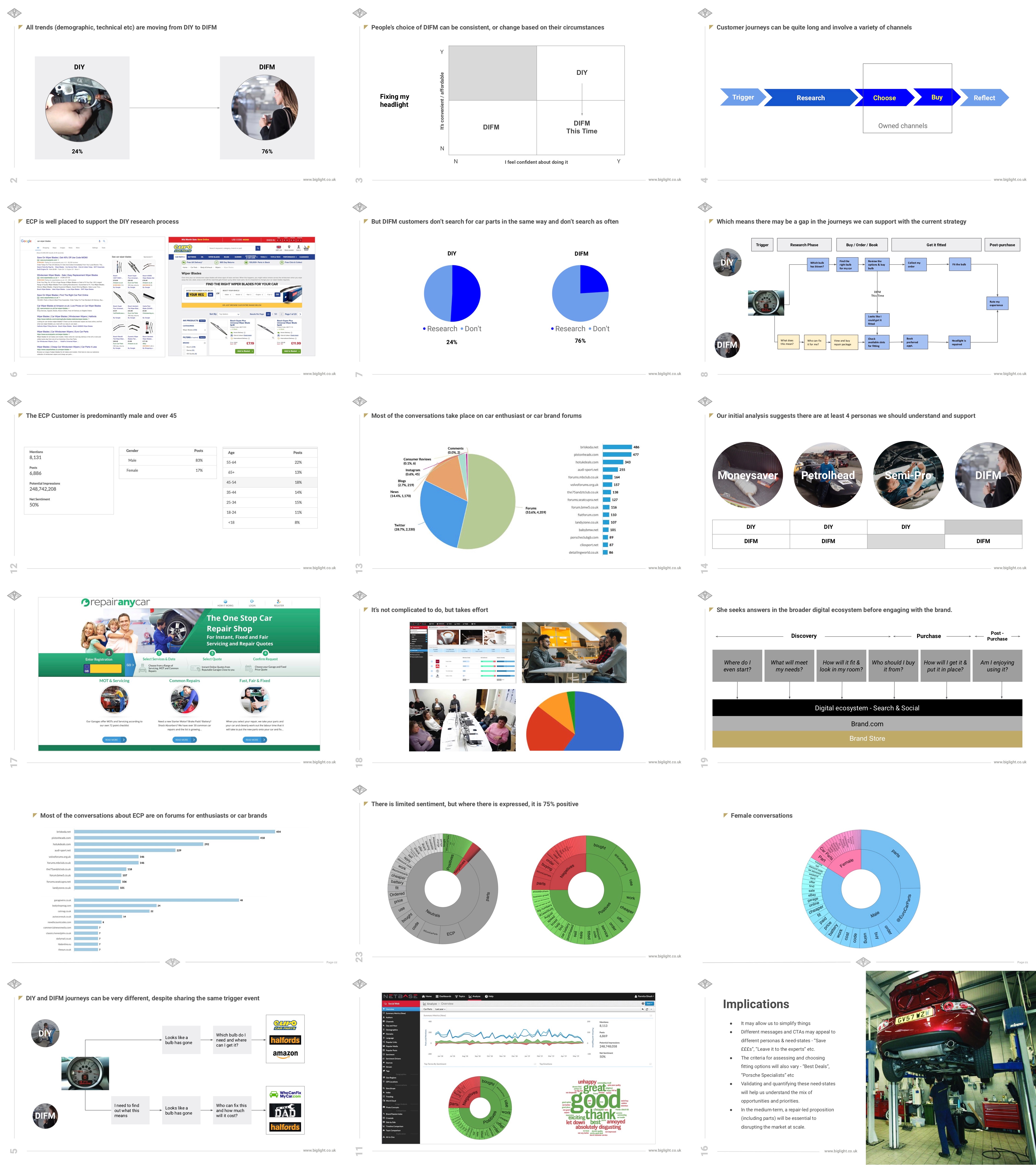
It was interesting to discover that there is a shift in the customer demographic of the car owners. This generation has more money on their hands but they are at the same time pretty time and price aware. They prefer to save money to buy a new gadget for example rather than willingly pay lots of money on a service.
The car ownership model is changing at a different pace so a car is less and less desirable to actually own, this is affecting how much money customers would spend on fixing and fitting their cars.
06 — LandscapeResearch
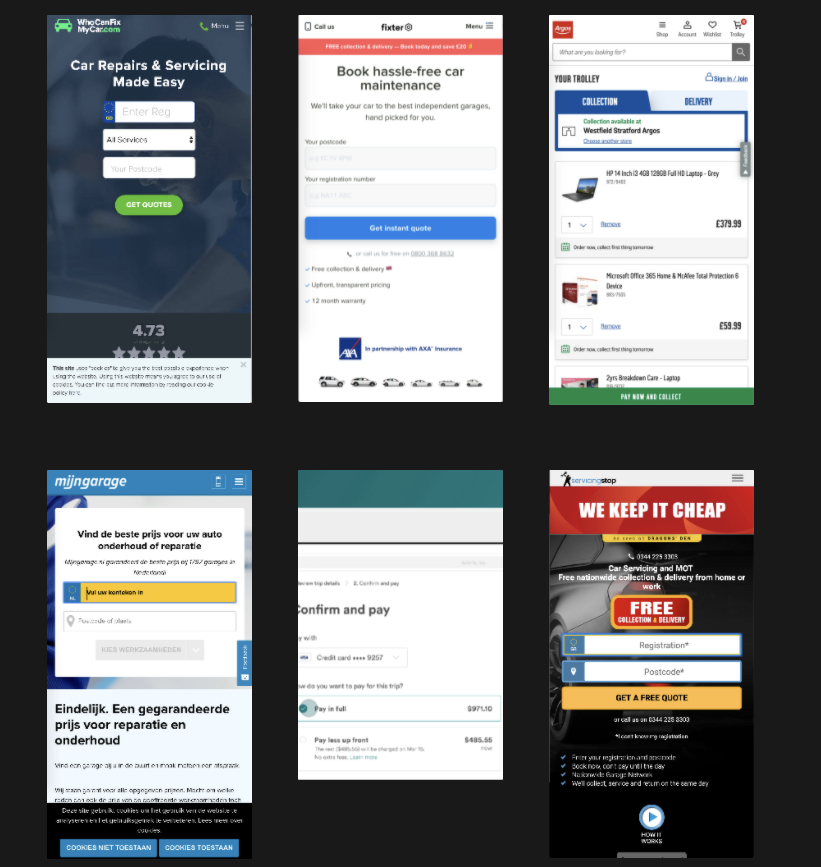
In order to kick-off the ideation process we had a look over competitors and other relevant companies, looking to identify trends and patterns.
We found lots of standalone services that paired customers to garage services, but none that start this journey directly from a basket place.
Things we liked:
- A way to split the availability of basket items via the delivery or collection method — Argos
- What you pay now vs later — Airbnb
- Multiple checkout - Farmdrop
- Booking a day over a timespan of 1-2 weeks - Specsavers
07 — FlowUser flow
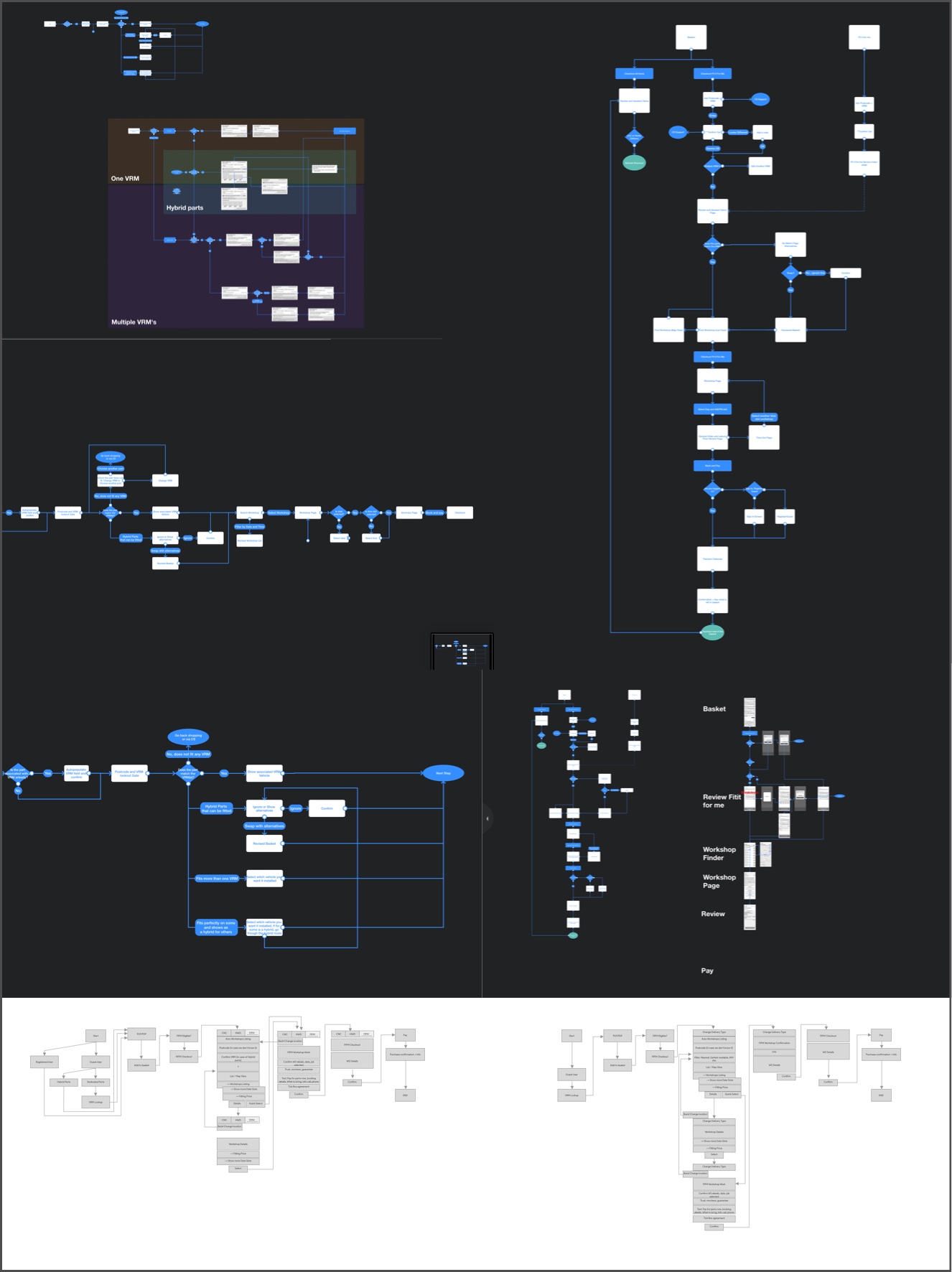
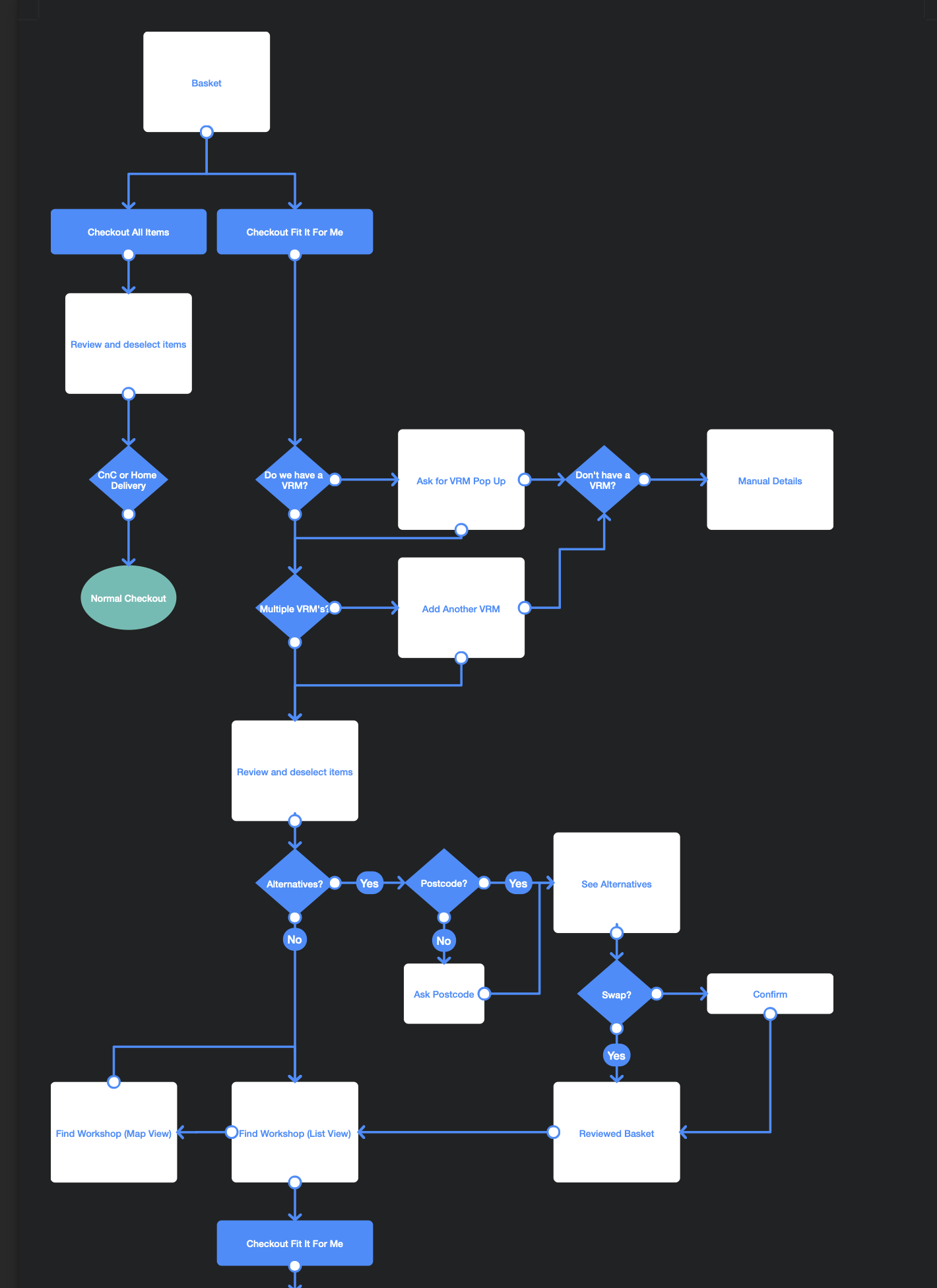
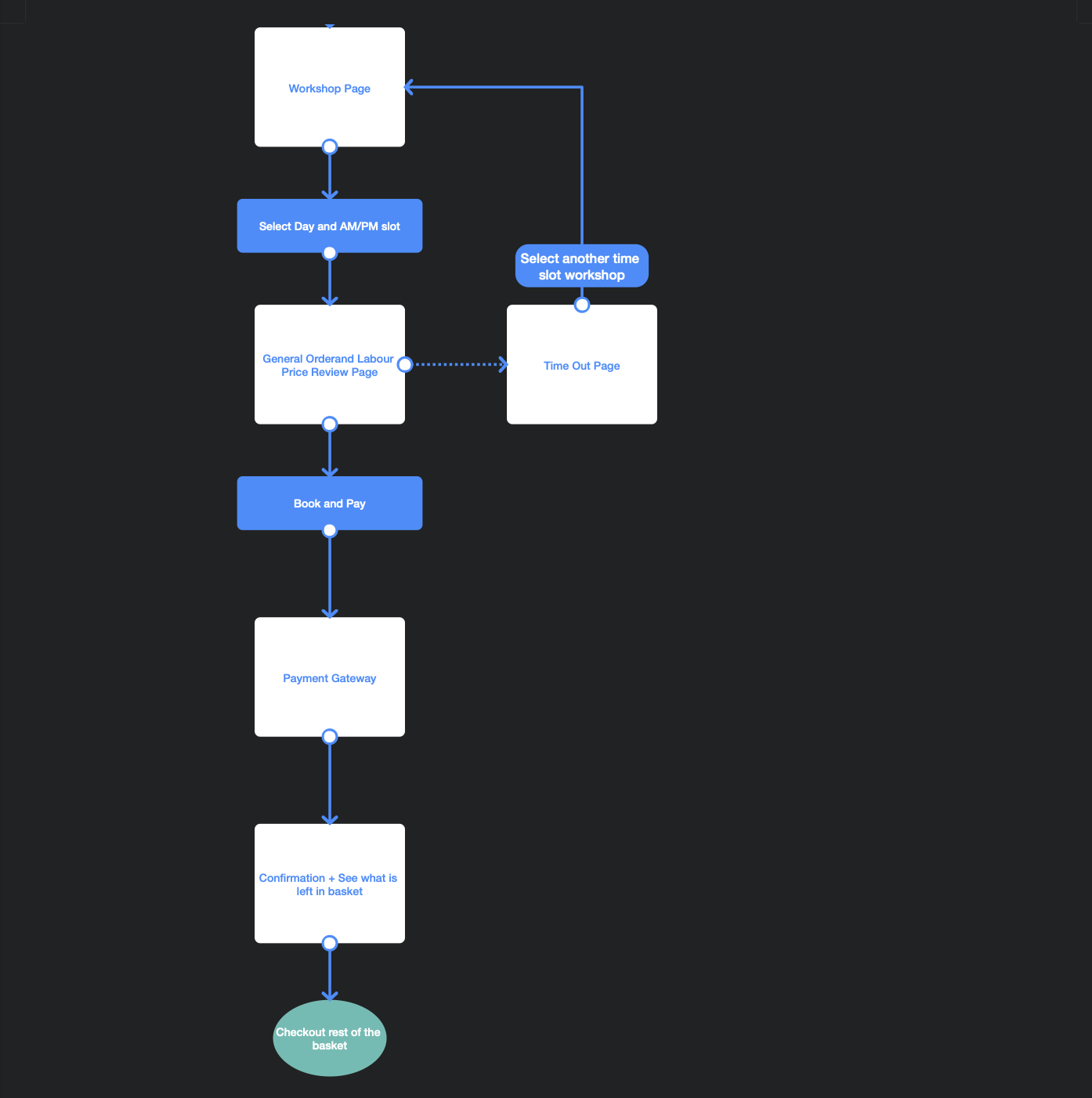
In order to start designing we had to decide the steps taken for every function in the plan. So I started to sketch an ideal path and then validate it with the tech team in order to see the backend process for each step. Things like server queries, input requirements, timeout cases.
08 — InsightsFindings
People would like to know upfront if a certain part is eligible to be fitted. Extra points if we can upsell by providing a quote like “This part is eligible for Fit it for me from £59 at a nearby garage”
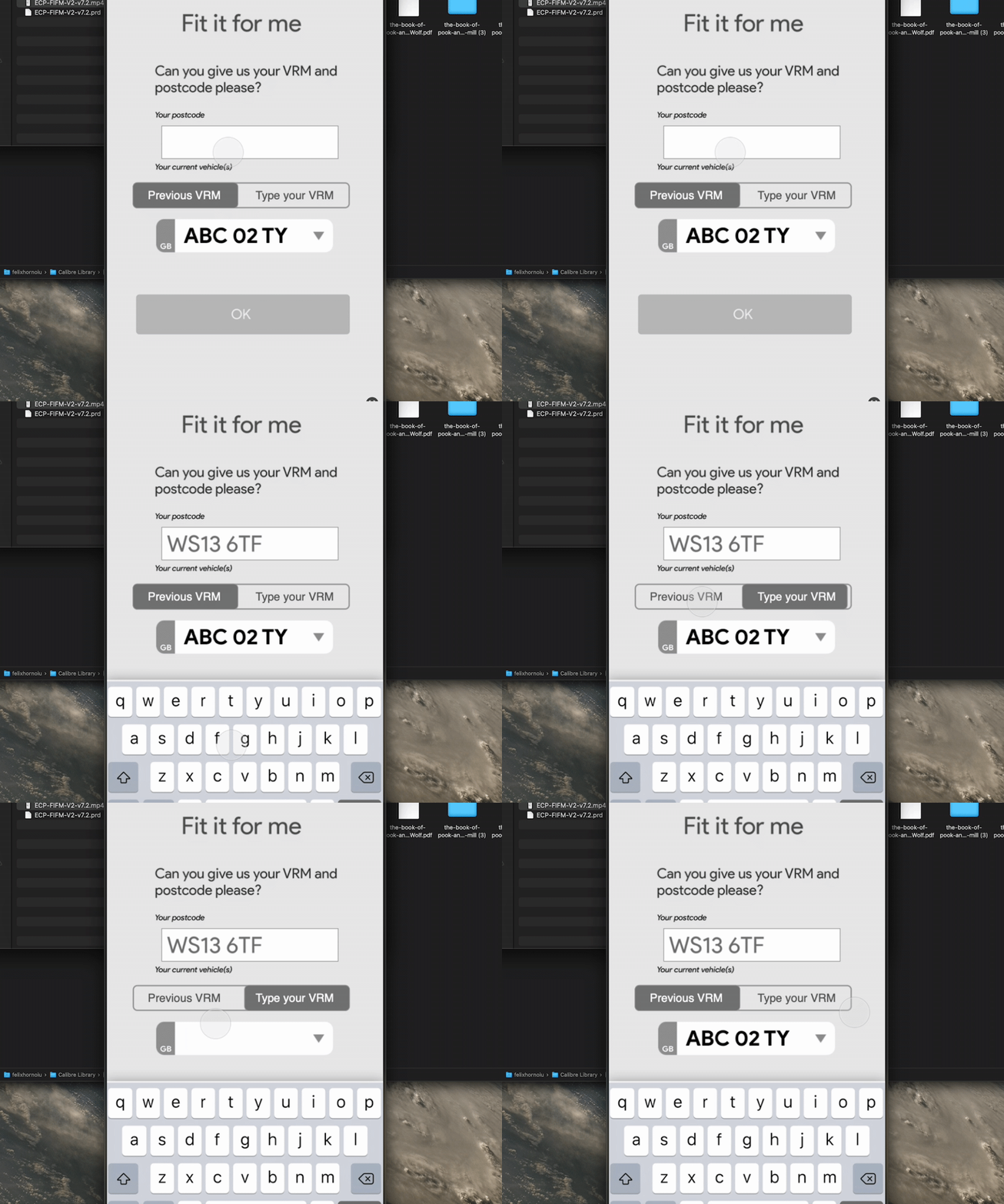
Postcode LookupQuotes can be generated only after we knew the postcode of the customer, as every region has different hourly rates. If we didn’t have the location of a user in the system (from previous purchases) we had to create a postcode prompt before the prices are shown.
Vehicle Reg CheckThe Salesforce database sometimes provided multiple VRN entries, as a household may have multiple cars, so we gave an option to select from an existing plate, or to type a new VRN number.

Multiple VRMsWe started with the premise we’d support multiple vehicles — say you want to fix two or three cars at once. While the complexity sounded exciting, and I built a version showing part compatibility against your stored vehicles (the ‘garage’), it turned out to be too much information for users to get around. In 95% of cases our typical user only wanted to fit or repair one car.
At the moment of the Beta, ECP hadn’t supported online payments for the fitting price, so we had to test and find a good way to demarcate and signpost the price you’re paying Now vs Later at the garage.
We tackled most edge cases through design, considering dev and system limitations. When a really rare situation appeared, it was handled via customer support.
Due to system limitations we were unable to offer hourly time slots — the only two options were Morning and Afternoon, with the exact hour determined over a call or at the location. Update: after 6 months of beta, 2h slots were added to the system.
09 — WireframesDefault Path
Once we settled on a flow I started doing the wireframes focusing on the ideal user, defining the required steps and how it can be implemented over their current checkout process.
10 — Feature breakdownFeatures
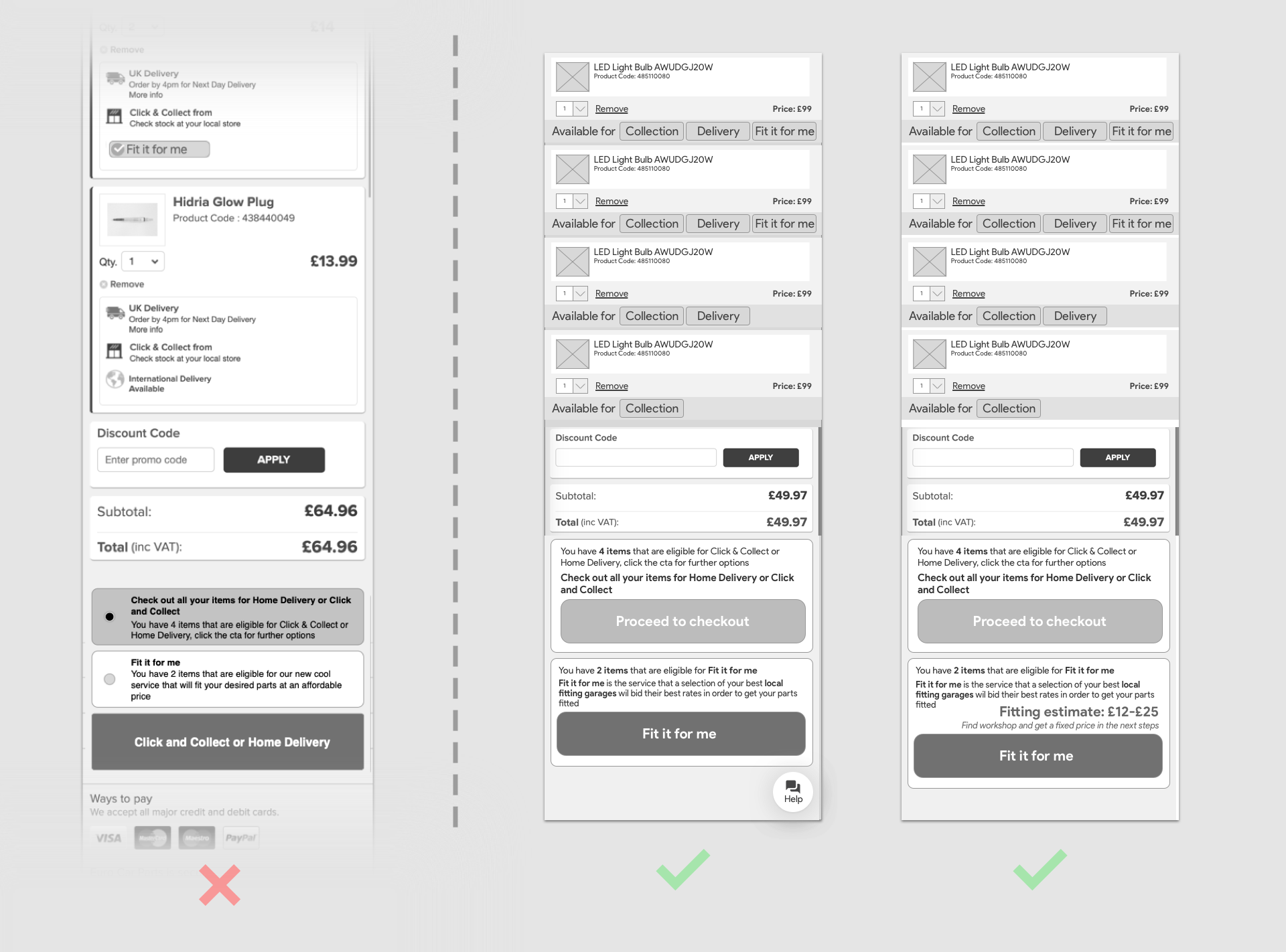
FeaturesBasket
In testing we’ve discovered the simplest approach is the best one. Even though we tried to avoid showing two consecutive calls to action, they tested far better than a selection option and a single CTA.
Key Points
- Straight forward call to actions
- Possibility to up-sell the fitting price by showing the estimate next to the CTA
- Each item has a badge showing the delivery options
FeaturesPostcode and VRM
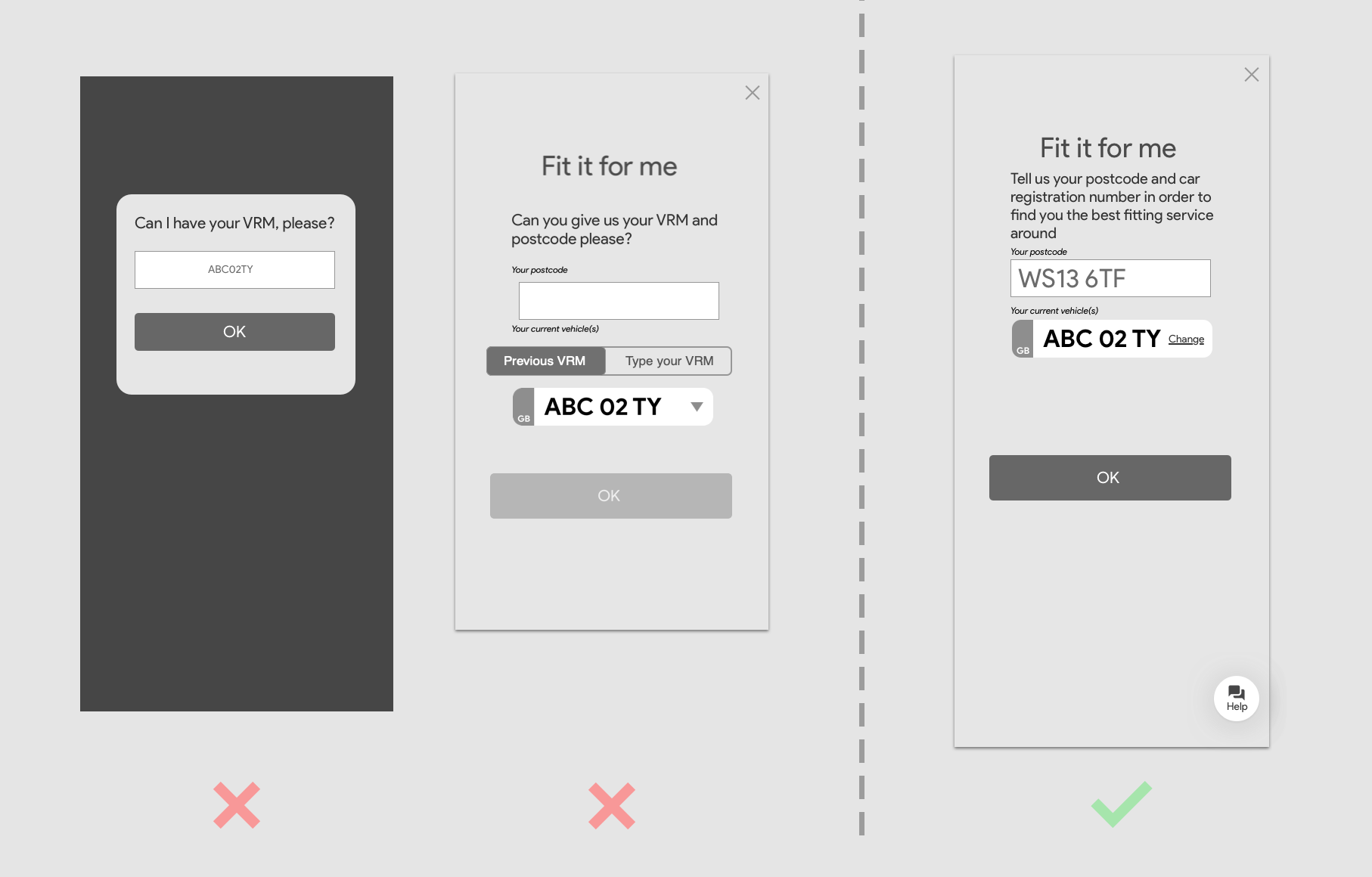
We debated how to ask users for a postcode and vehicle registration from the start without creating an extra effort. Some items in the basket were bought with a VRM, some don’t require a VRM and some are bought by their serial number.
In this case I created the ‘Postcode and VRM Gate’ in order to always verify before the next step of the journey.
Key points
- Less Options, clean design
- One page
- Potentially pre-populate the VRM field with the data from the basket
FeaturesReview Page
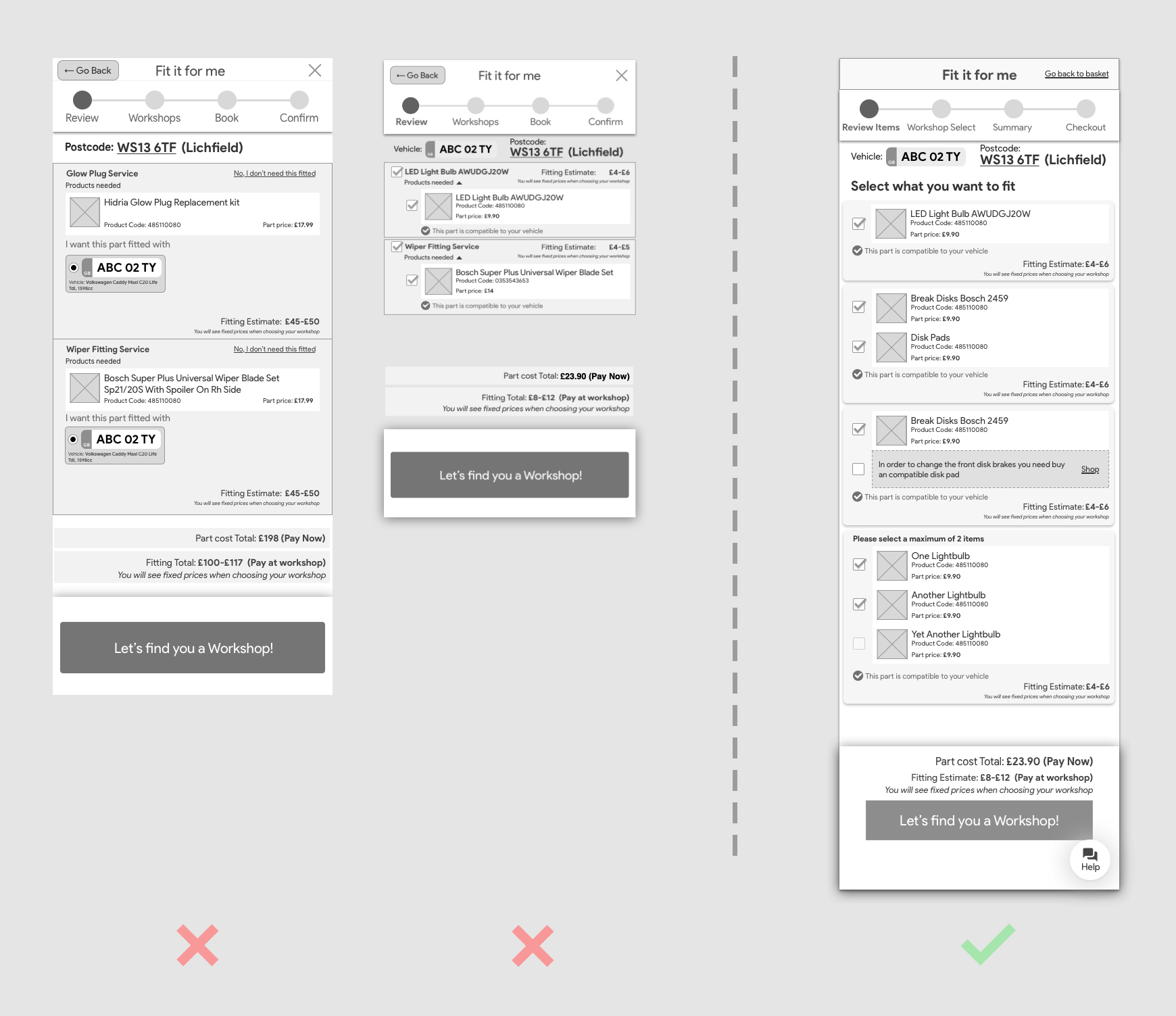
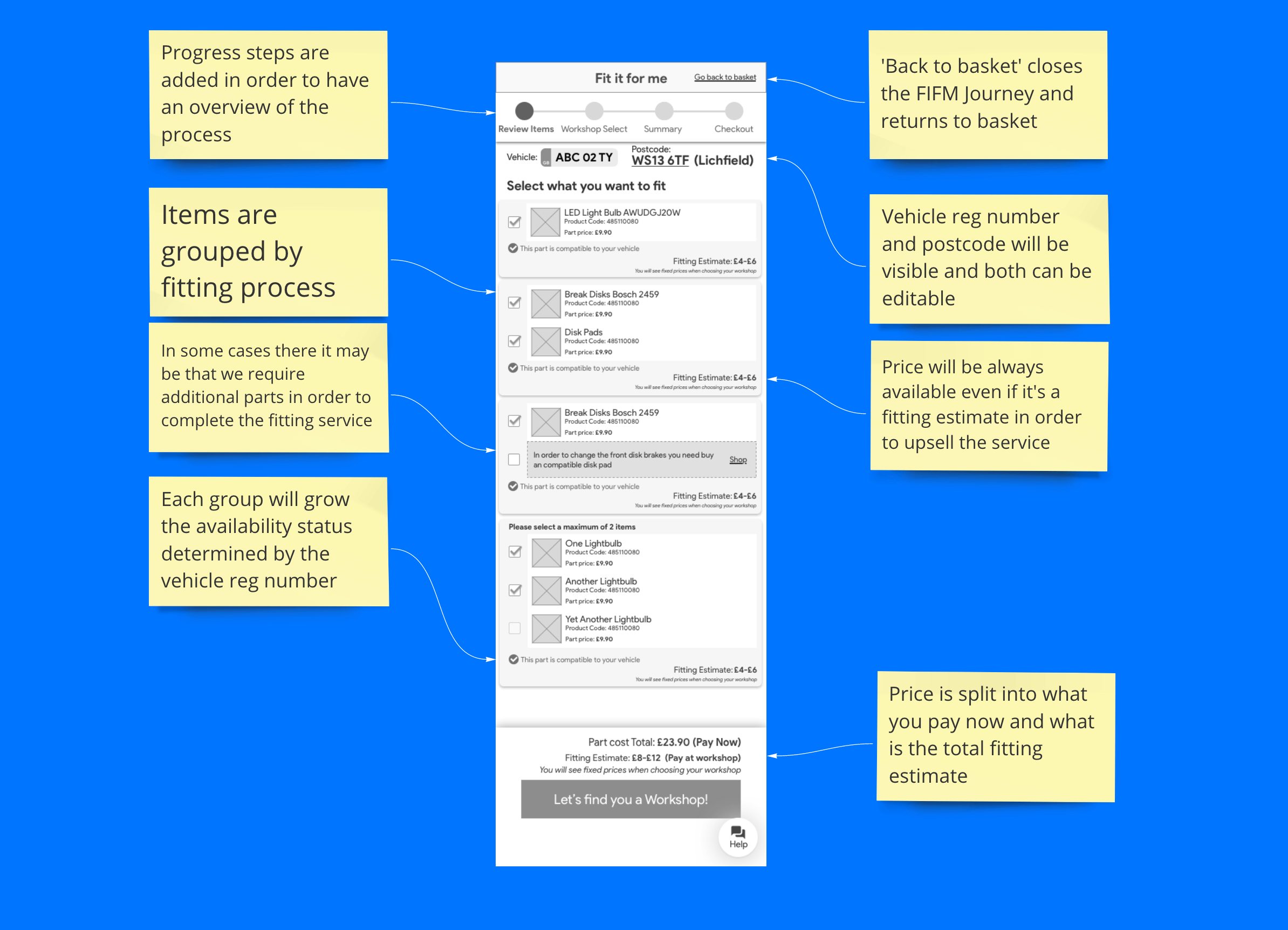
One of the challenges was how to group items in the basket; we tested a couple of options and we settled on avoiding the fitting name and just list the items, grouping them via pre-defined patterns.
FeaturesNice to have vs. compulsory add-on purchases (in the list view at checkout)
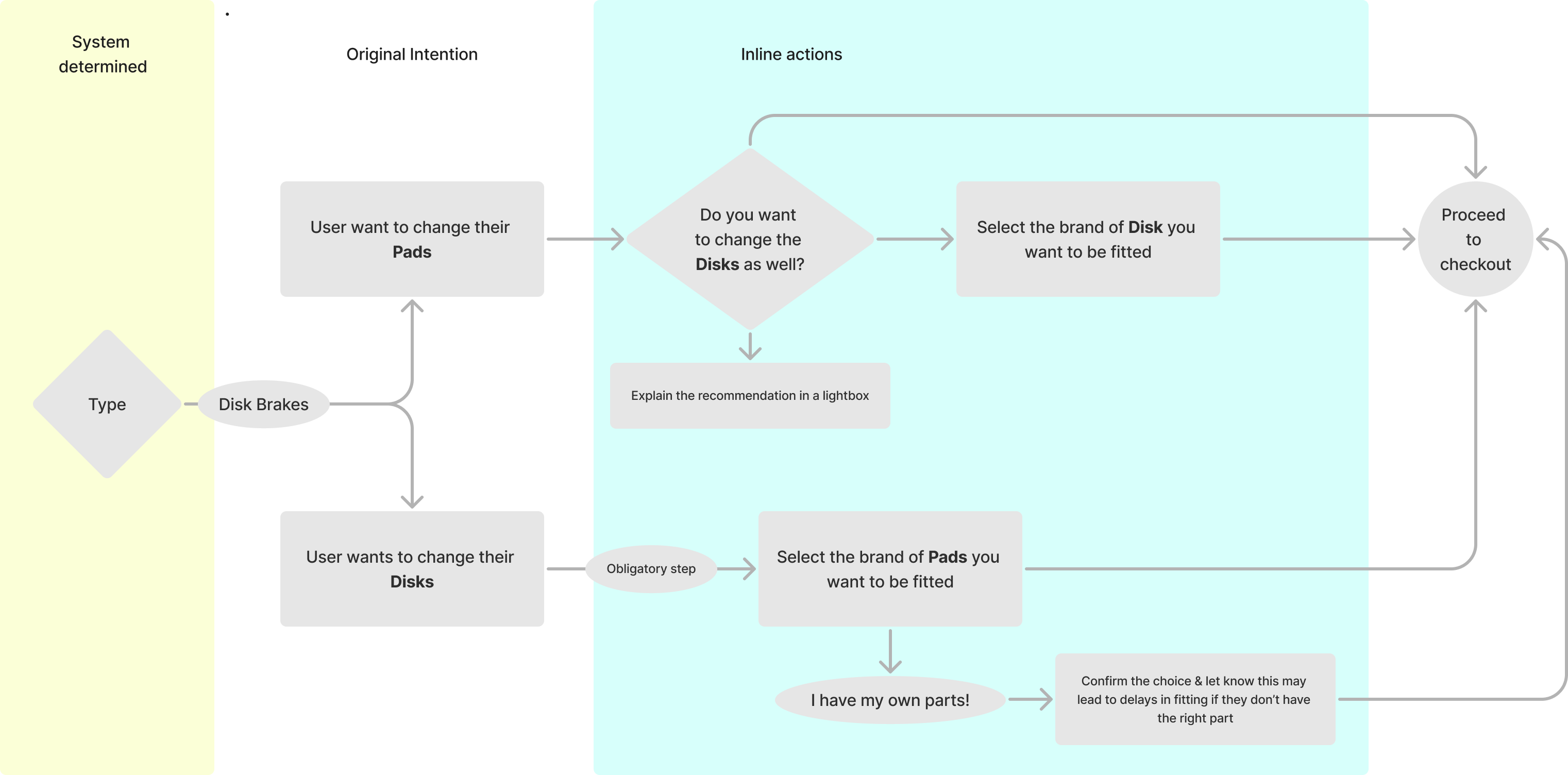
After we created an ideal flow we tried to tackle edge cases that were crucial to the business, such as the interrelationships between components. I learned that you can rarely change one particular part when servicing a car, some are compulsory while others are just an advisory and are nice to have.
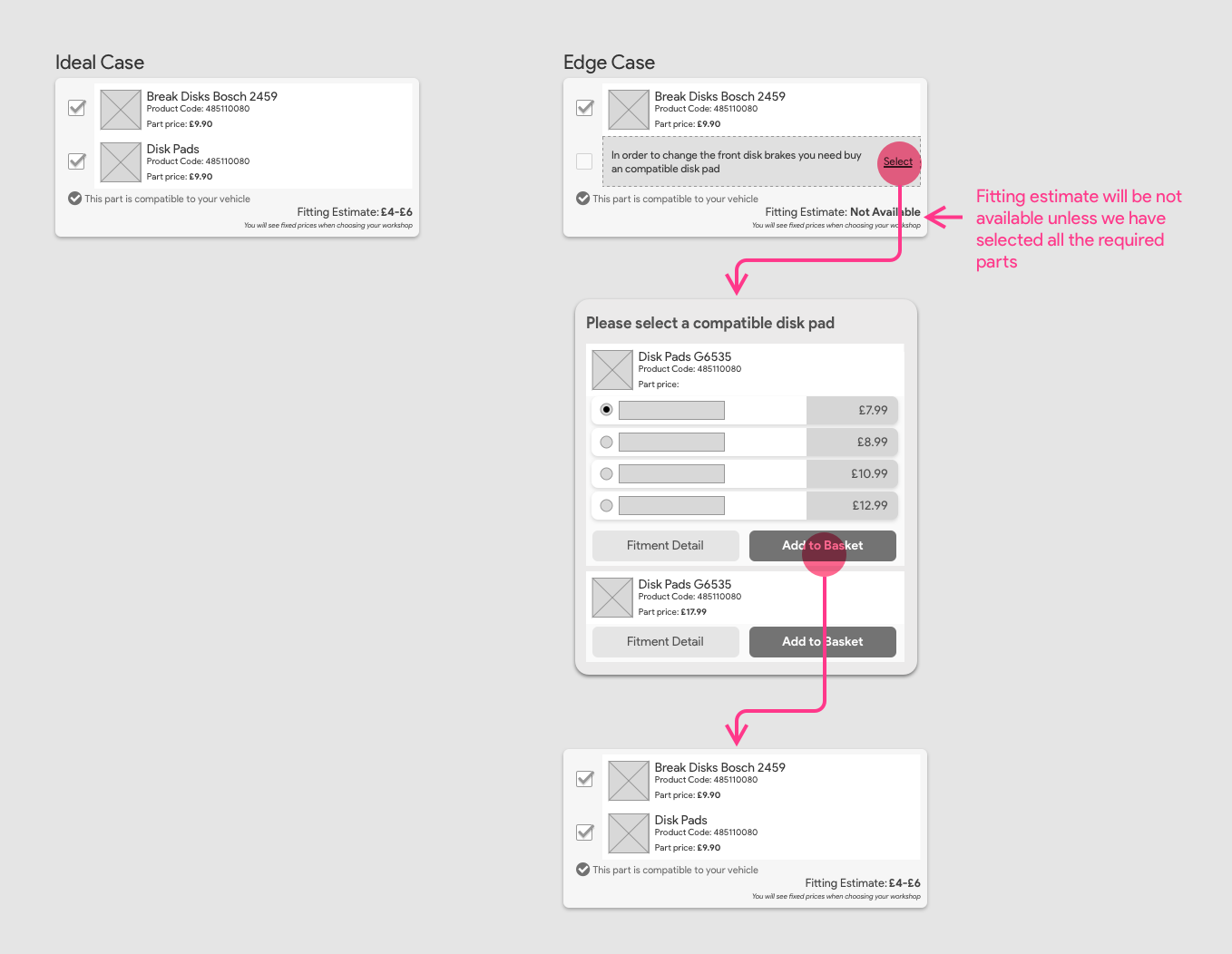
Following is an example of the disc brake system on a car. Disc brakes need a set of regulatory rules because they are a vital part of the safety of the driver and others. As every brake wears out differently, it’s important to change all items at once and always have a set of new parts. You can change the pads a few times, leaving your discs as optional, but you cannot change the discs without the pads.
Below there are two modes of experience, the one above shows how a customer buys a pair of disc pads while having an optional route to get new discs as well, while the latter is a flow where they are guided strictly to select a pair of pads, unless they have already purchased earlier or happen to have a set of pads as a spare in their garage.
FeaturesCorrecting a purchase
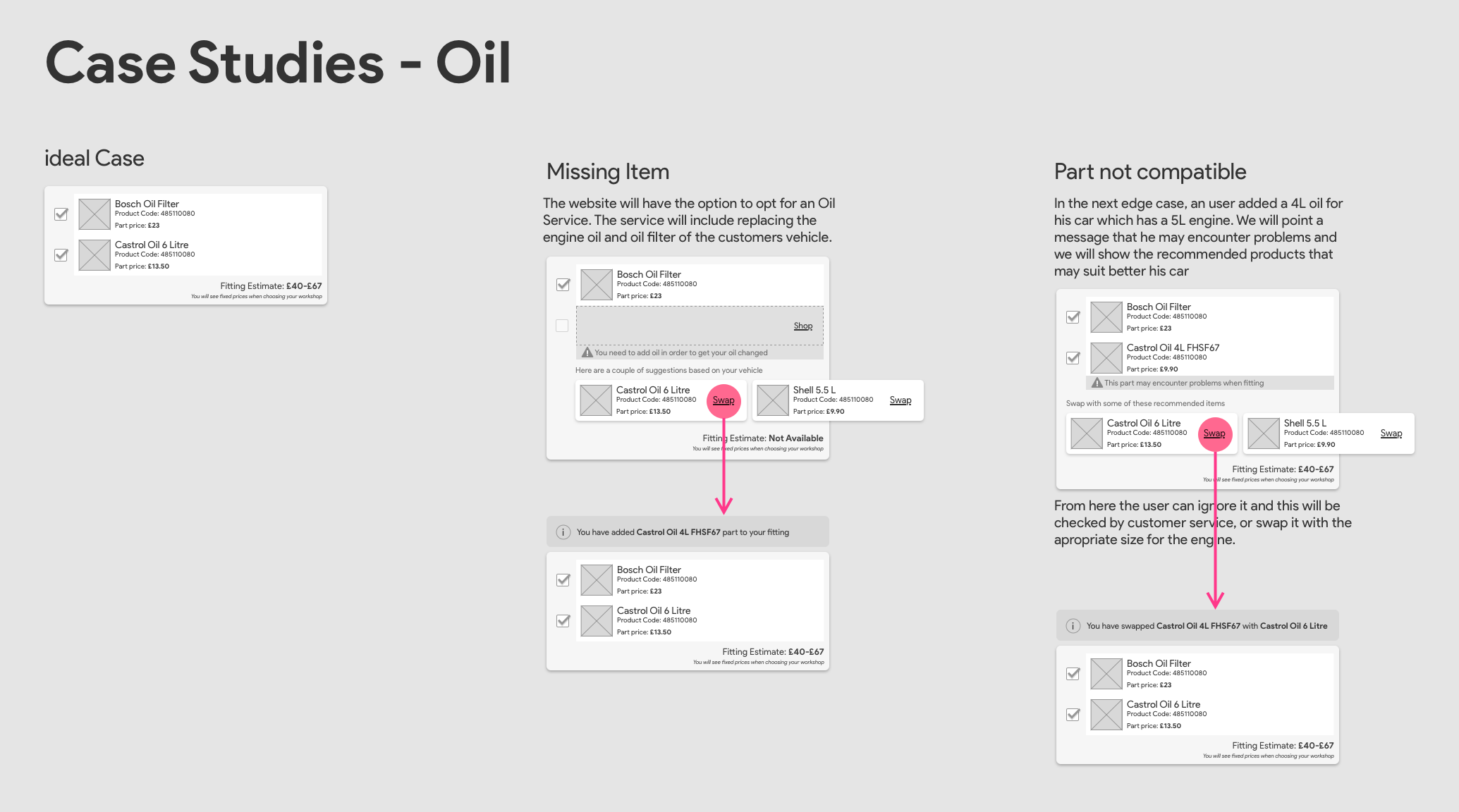
We tackled some edge cases when a product is flagged as not perfectly compatible — for example, the amount of oil that goes into an engine.
If the customer got a 4L oil change kit, but in our system we detect that the car has a 5L engine we will prompt the option to upgrade inline on the cards — while leaving the option to continue, in case the user has some spare oil in the garage.
FeaturesCompleting a purchase
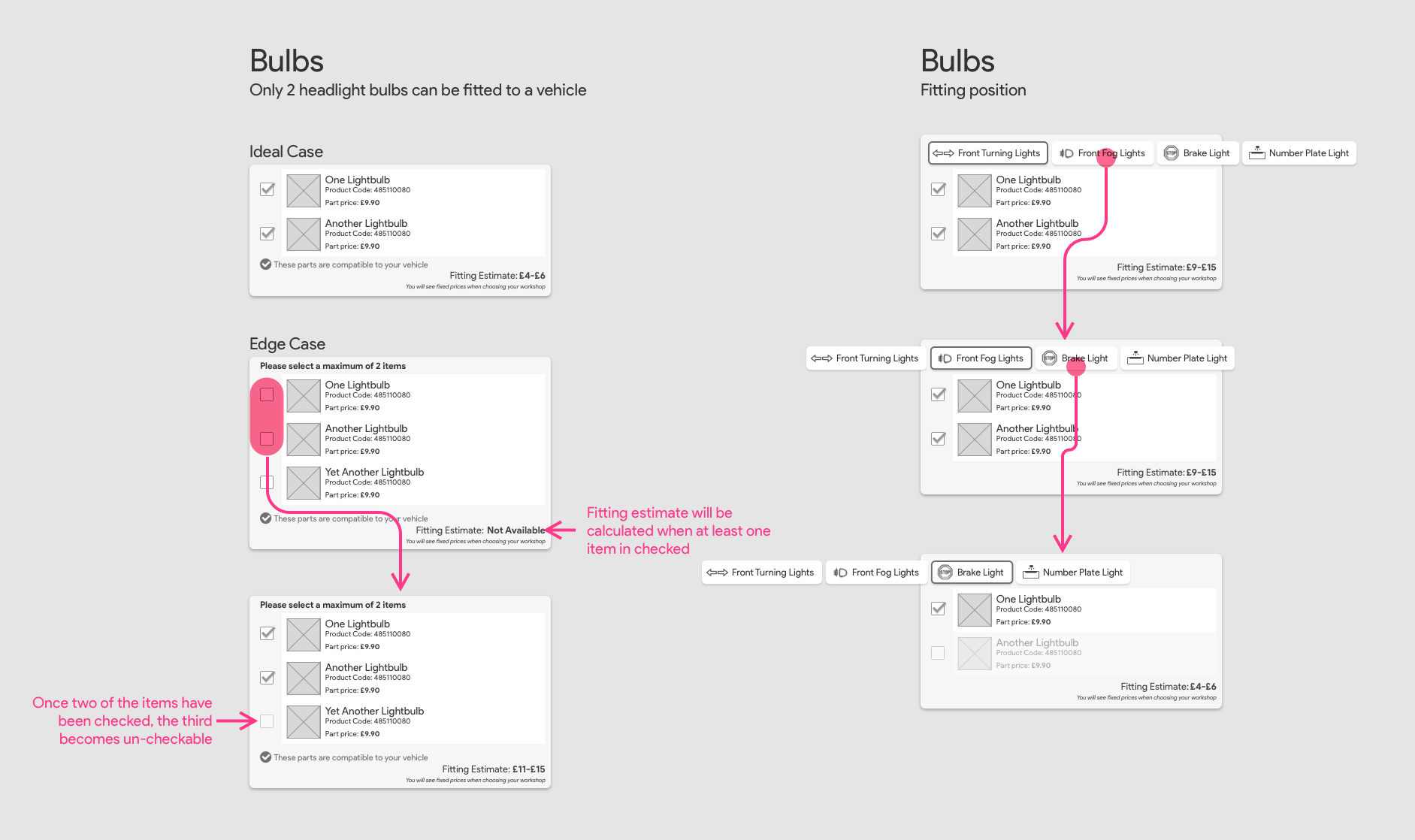
There are situations when ideally a purchase needs to be completed by additional products; it’s not mandatory, but we used design in order to inform and guide.
FeaturesSelecting a Workshop
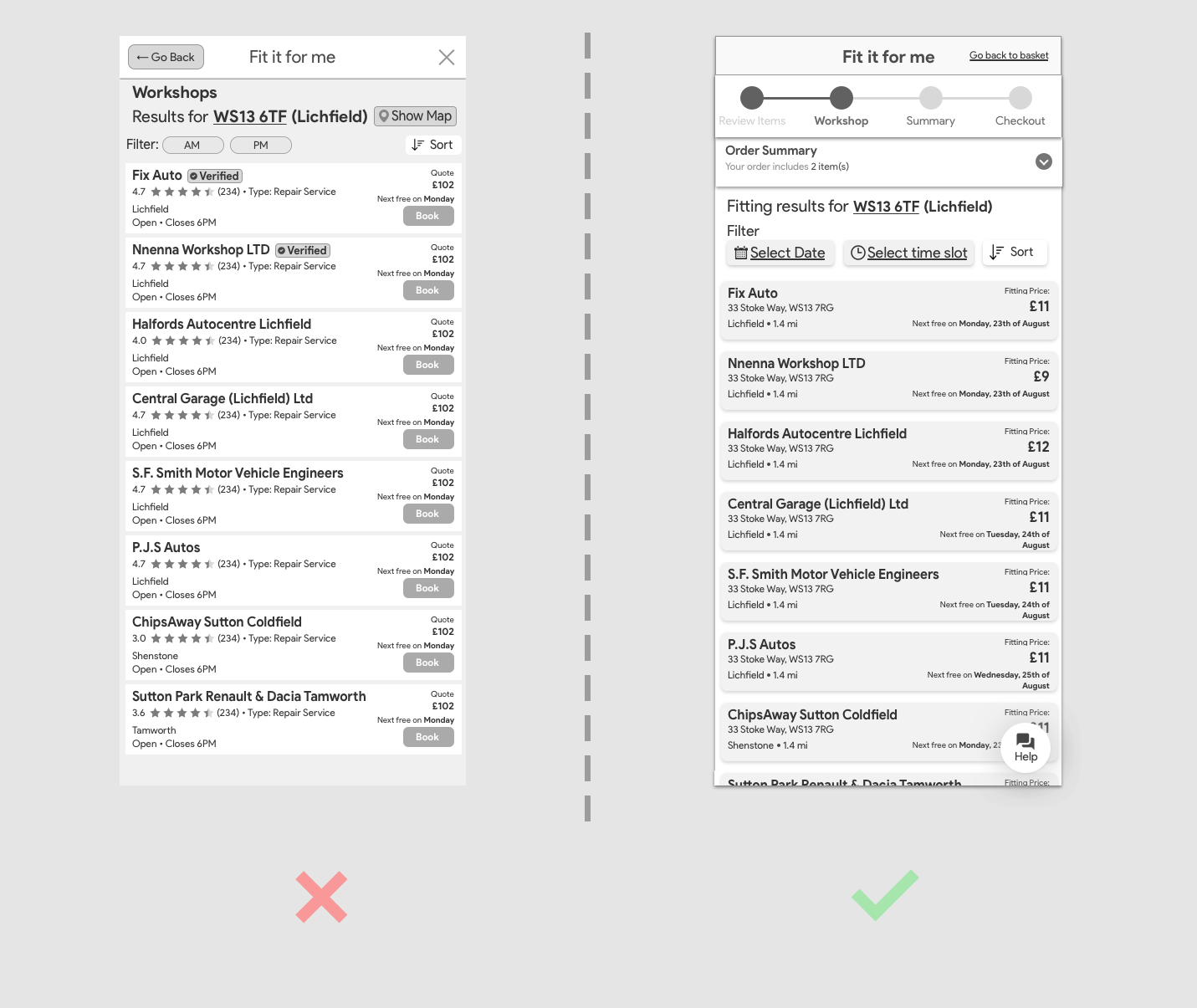
In listing the workshops a lot of emphasis was put on the order of the listing. We did not have any rating system in phase 1 so we decided to list the garages in a ‘Recommended’ way, a mix of proximity and facilities.
FeaturesSummary Page
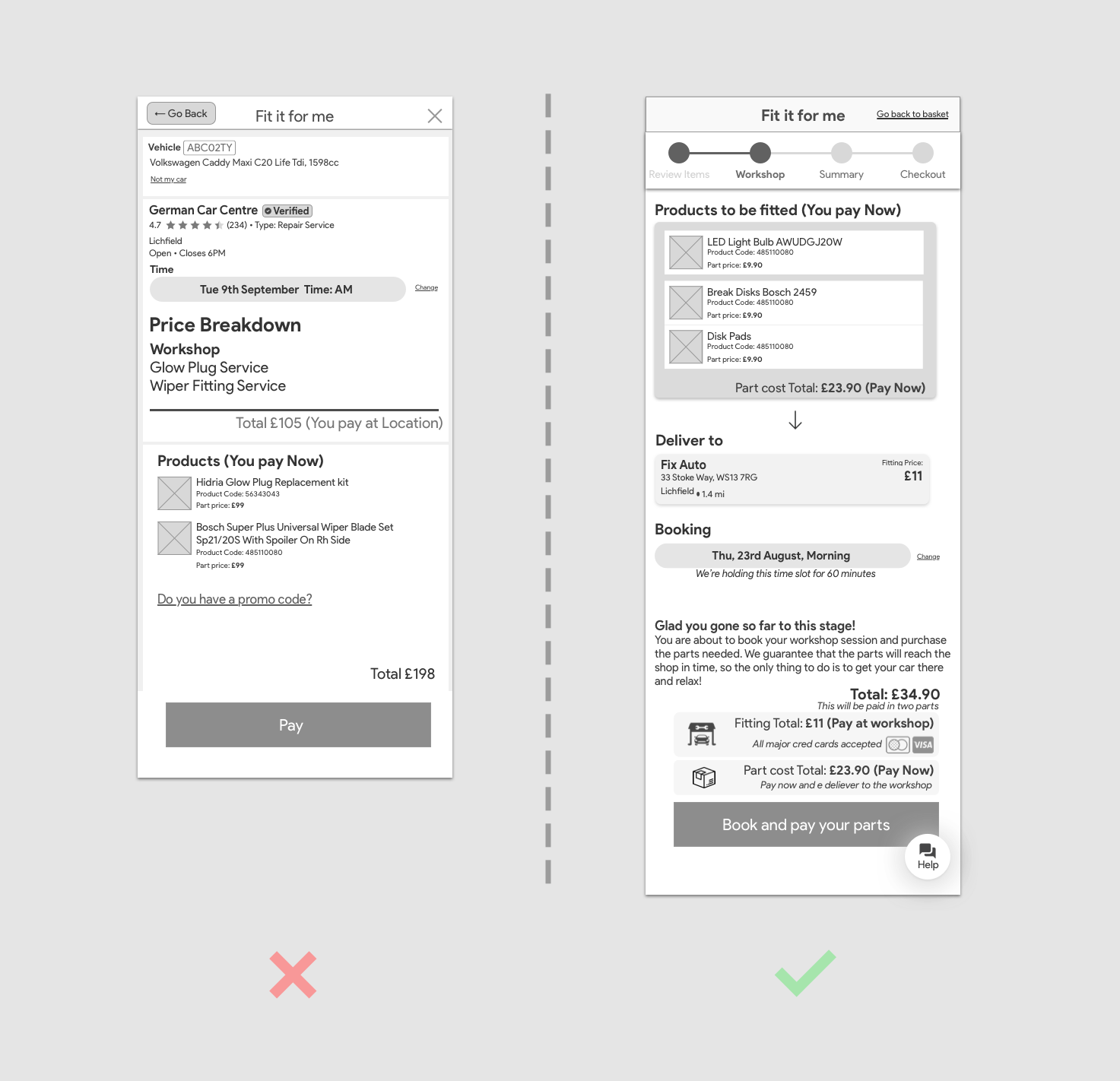
Lots of versions were made in order to see what’s the best version to show your products, delivery, booking and method of payment.
FeaturesFunctions: Selecting Date
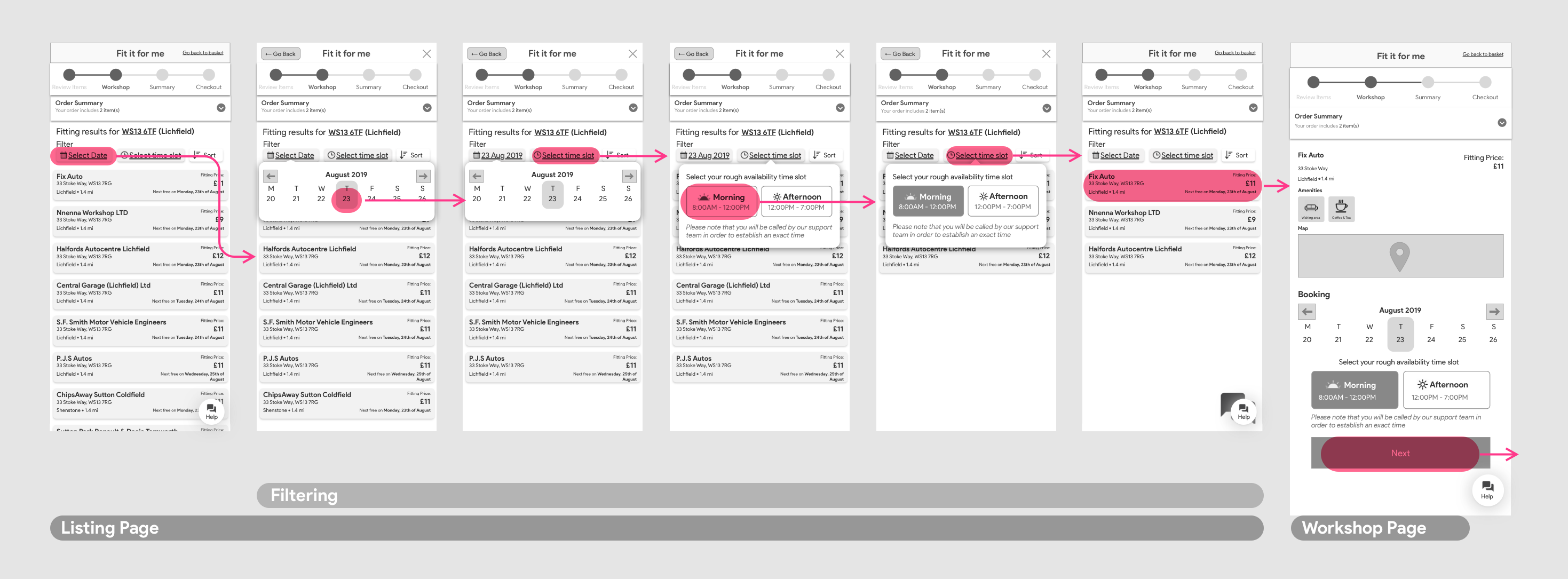
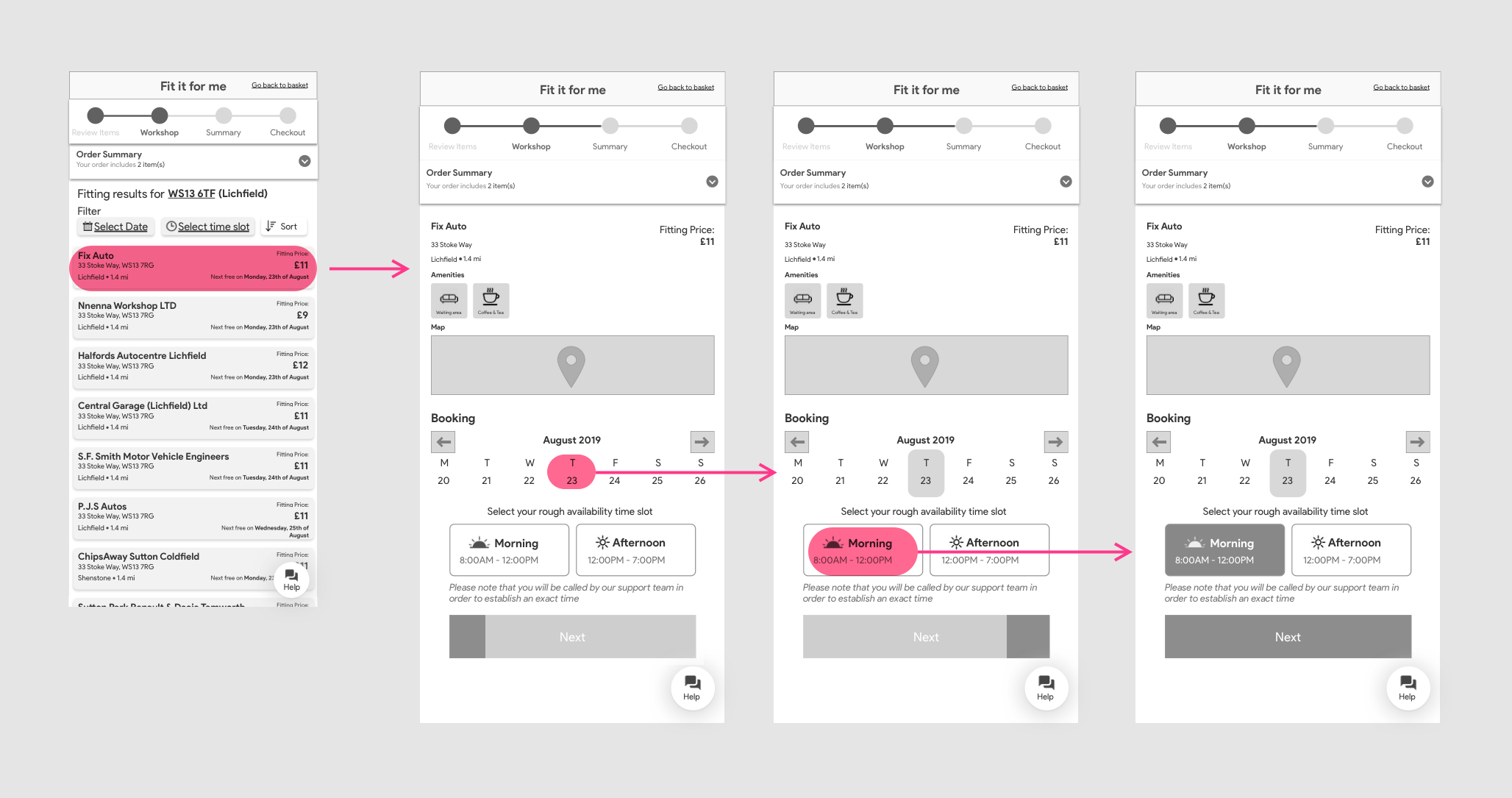
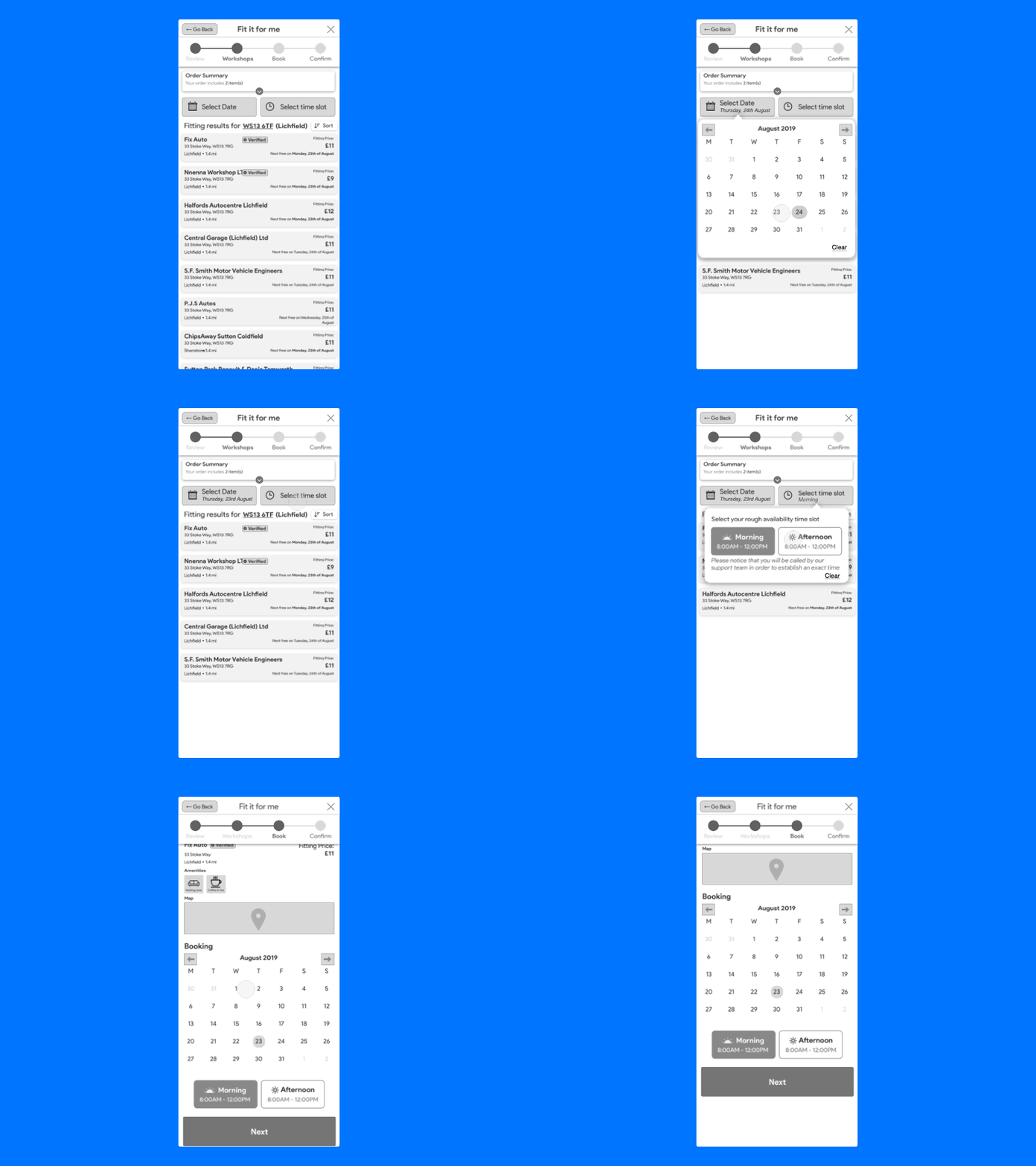
I created two ways to book the workshop in the platform, one is by filtering the results and one is by clicking and selecting the date in the workshop page. As we didn’t have a lot of testing budget we decided to use both, duplicating the Date and time Selectors for reuse.
Filters on top of the workshop results page are by Date and Time. You can start with date and this will update time slots appropriately or jump to time and then you will see what dates are available for that specific slot.
By filtering
In page
Selecting Date and Time in the workshop page is designed for people that are prioritising the workshop brand over their time. Once you are in the workshop page you can select a day and preferred time.
FeaturesDropout Points
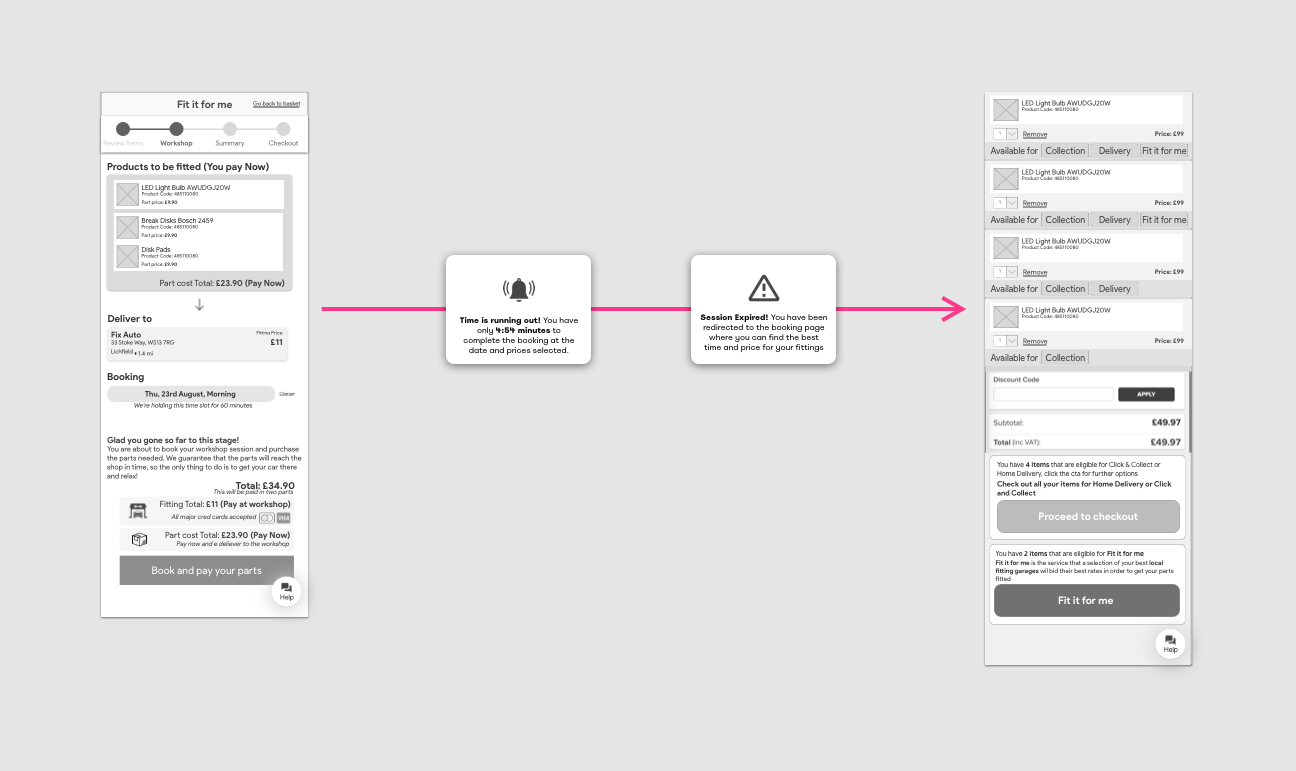
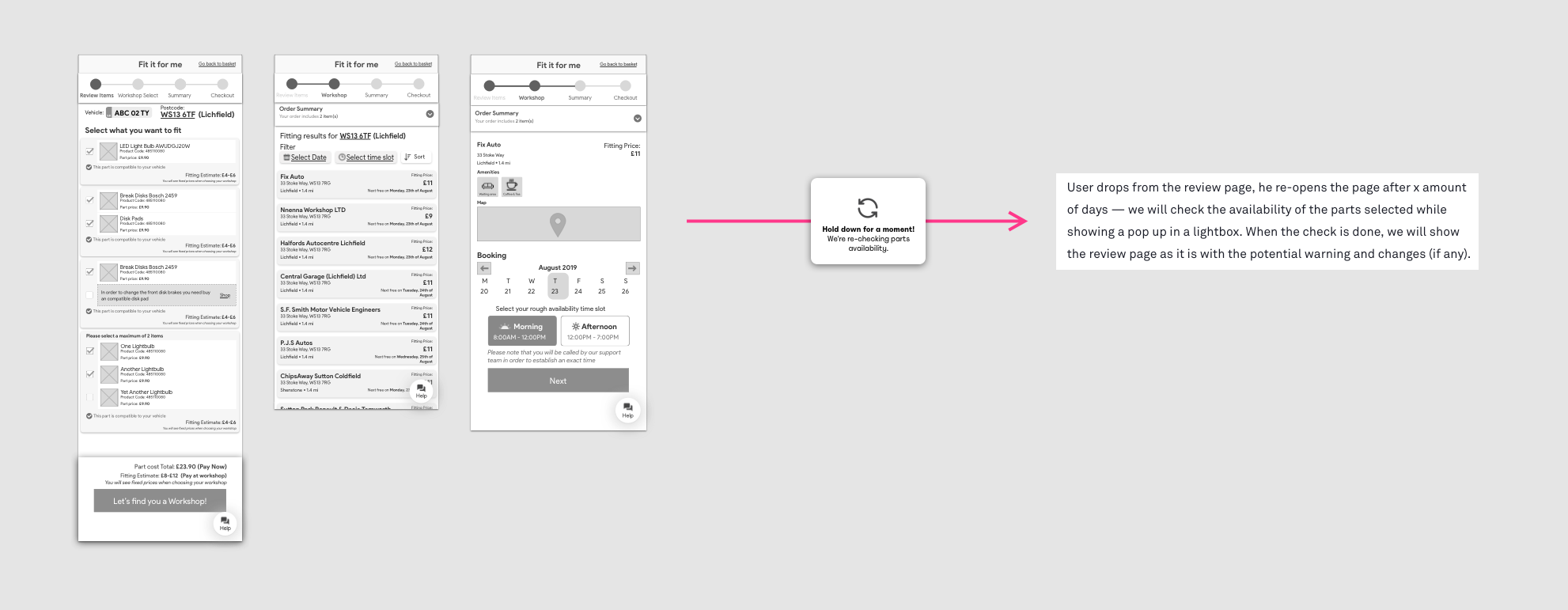
One important factor was to track any scenario when a user would drop off the journey and how long we can keep the selected slot on.
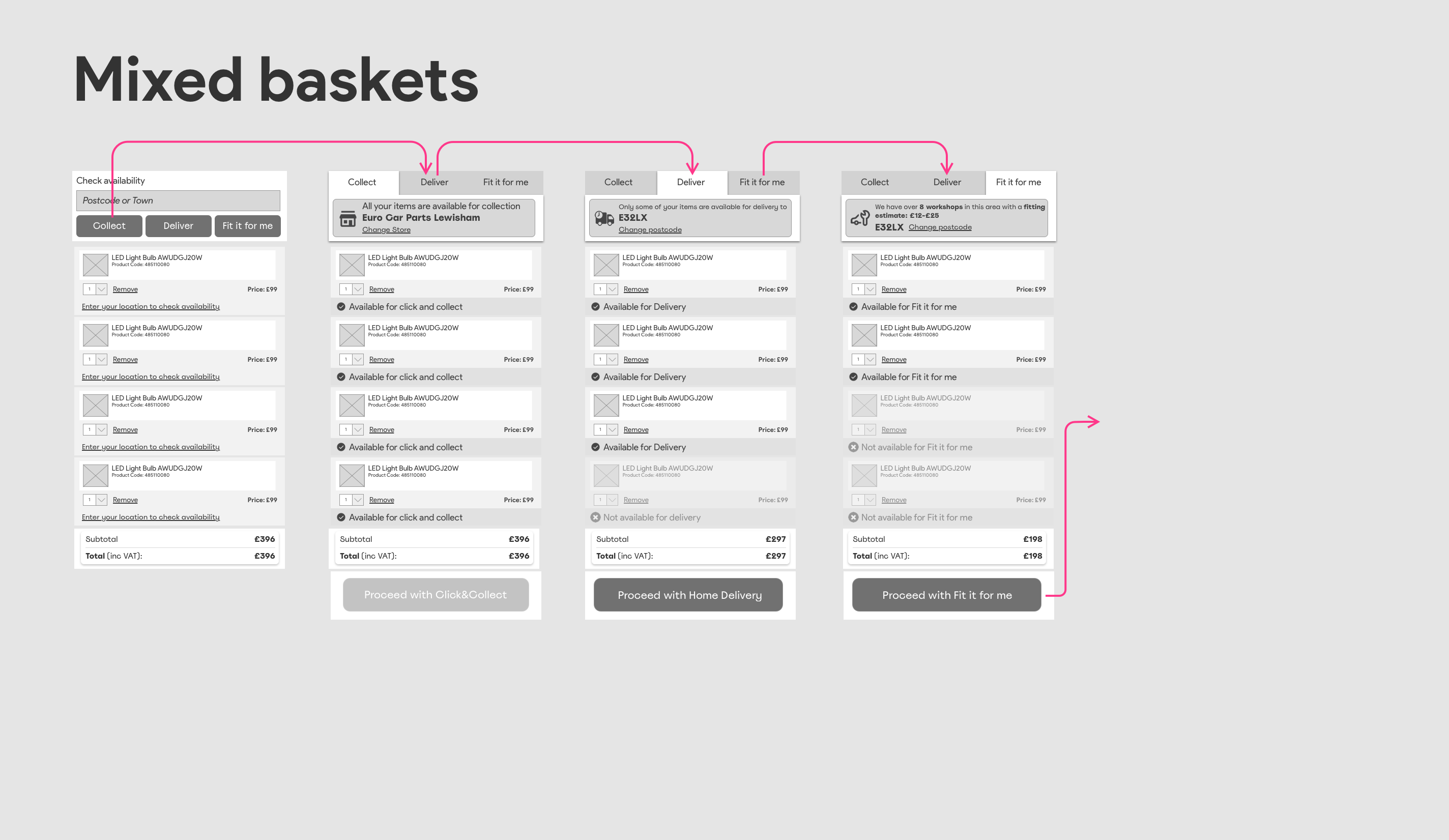
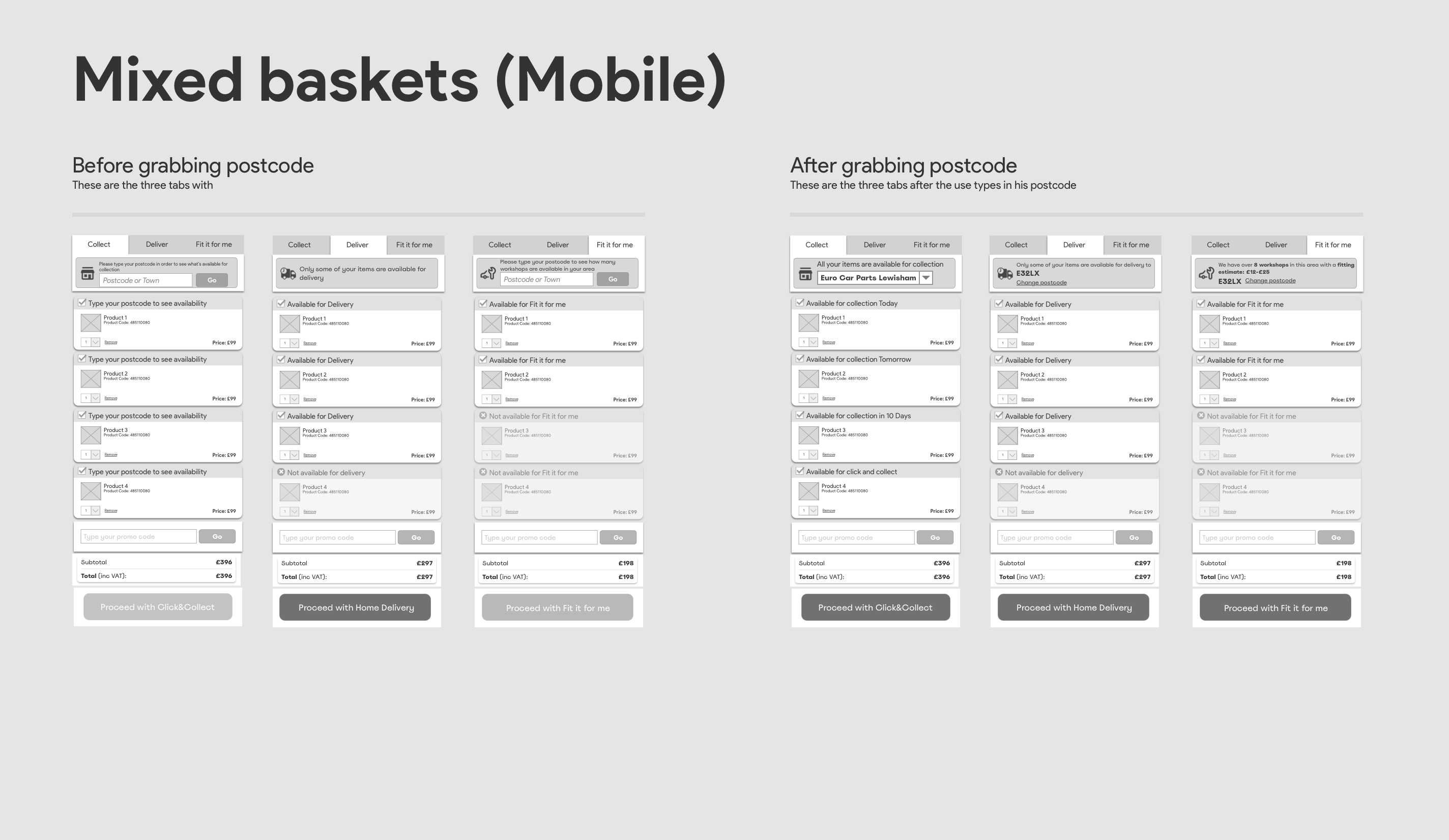
FeaturesMixed Baskets
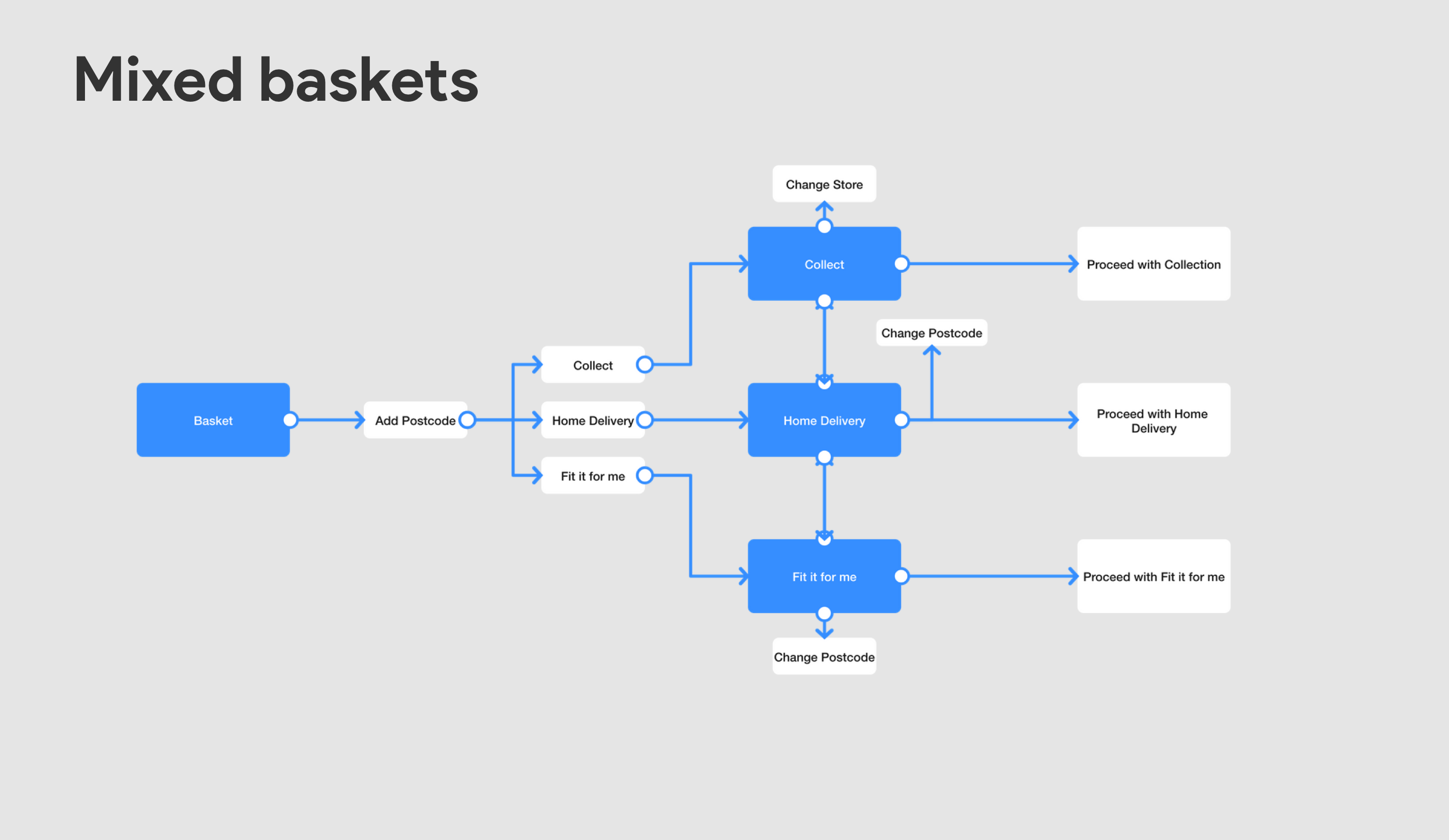
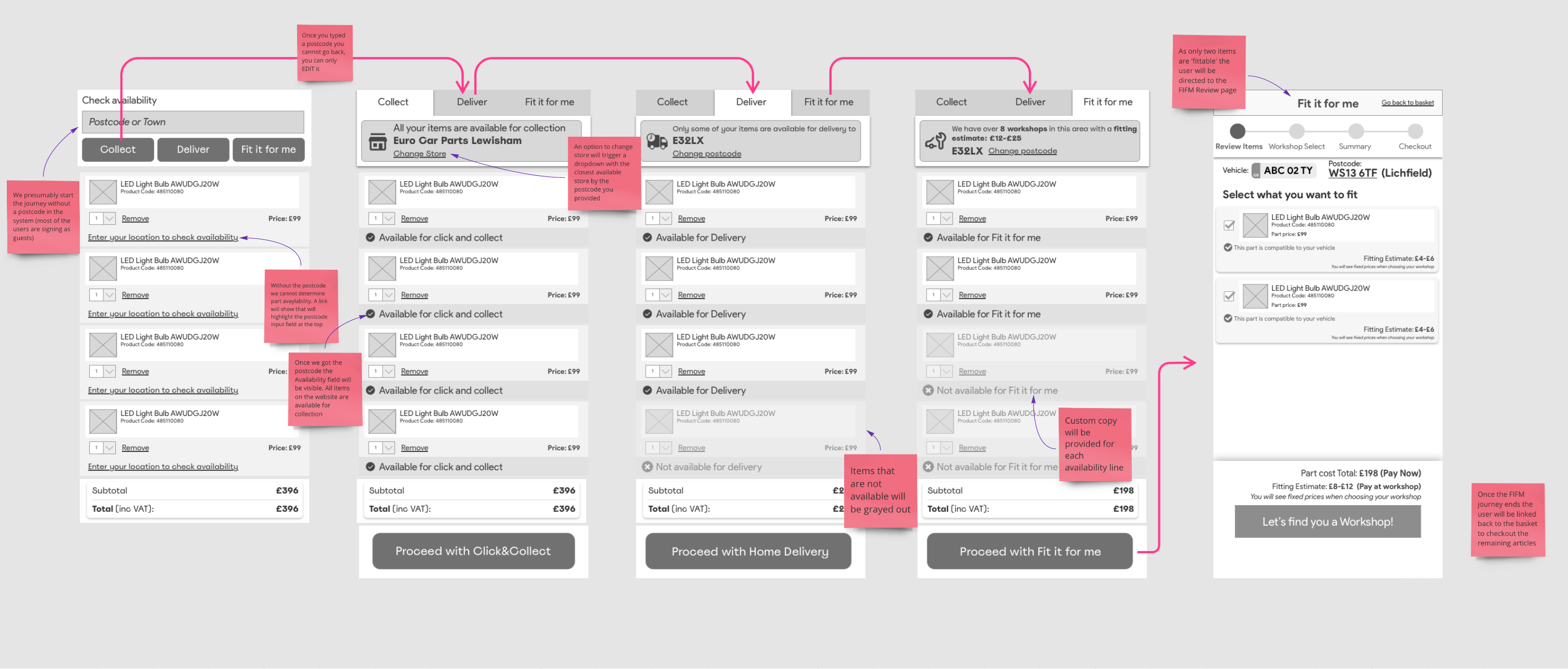
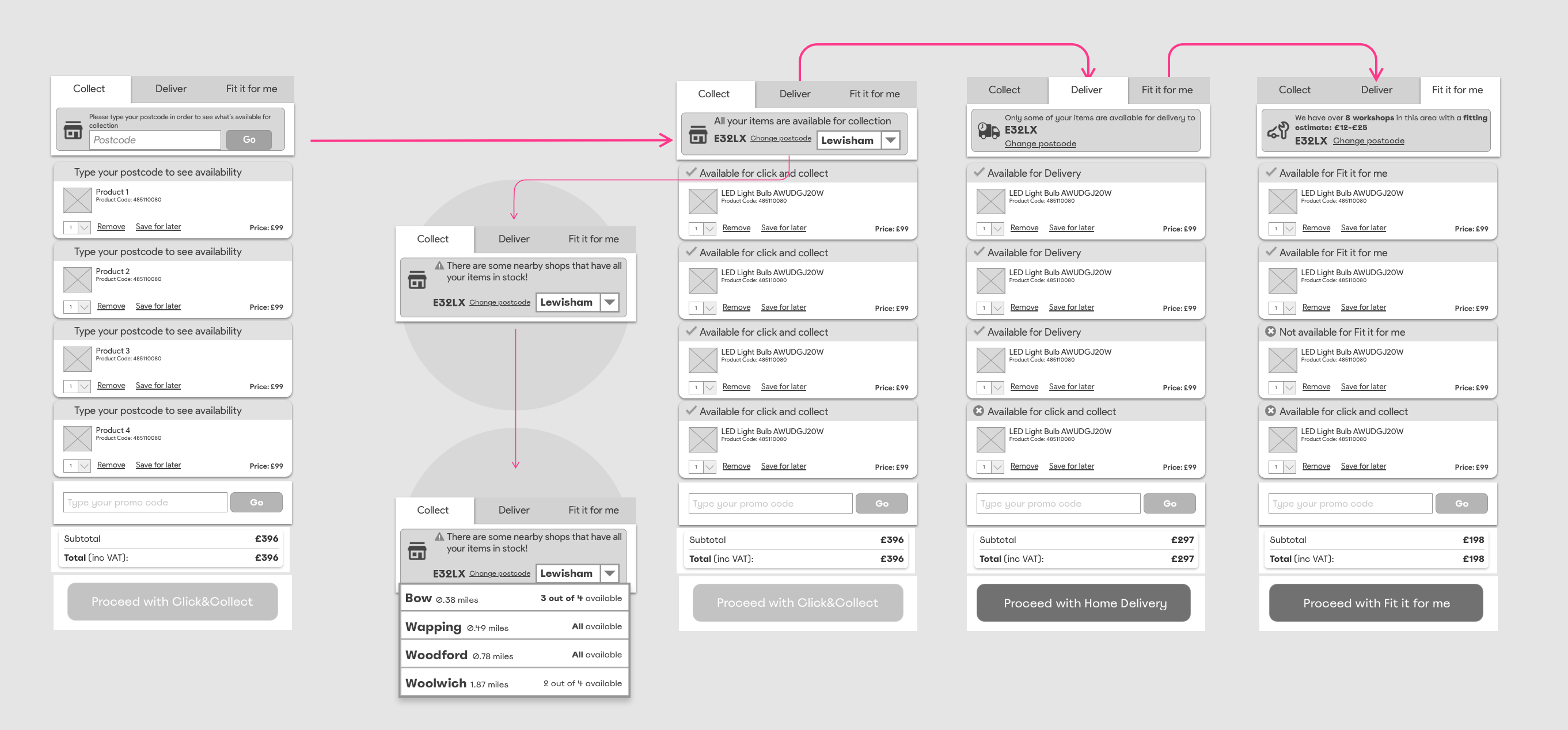
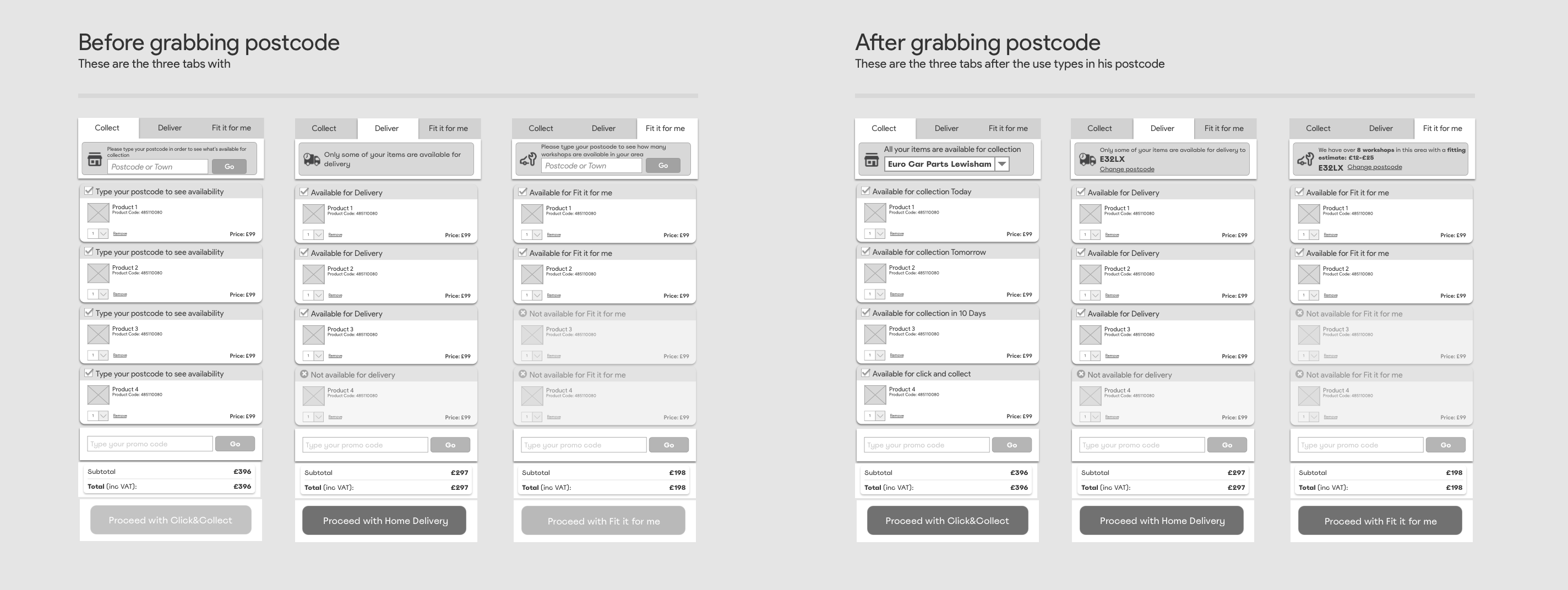
An additional feature for this project was to make branching out the delivery methods (Collect and Deliver) easier, and on the same level adding the ‘Fit it for me’ option.
The logic is creating three top tabs, the default one will be Collect because all items are available for collection, almost all for home delivery and some for ‘Fit it for me’ service.
11 — ValidationUser Testing
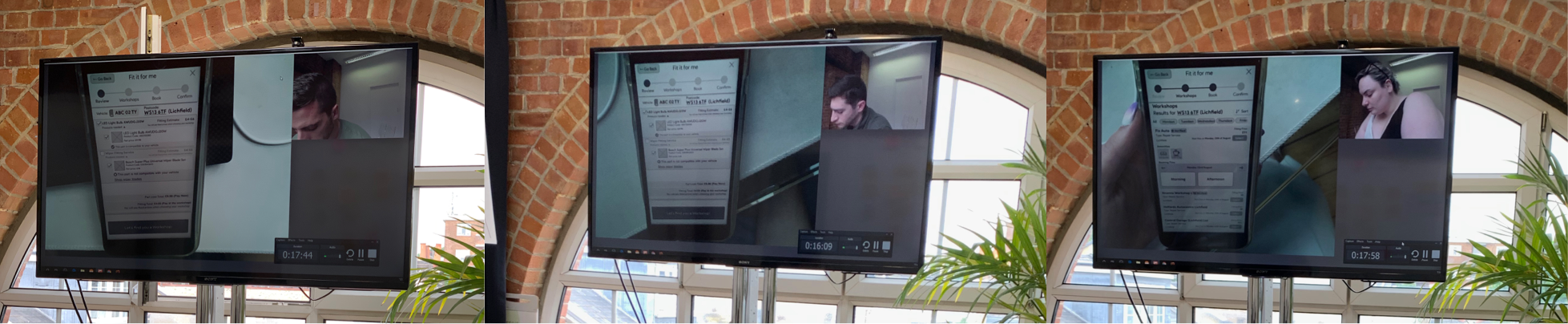
The tool we used was Principle, as we needed to create features that were not possible to test through image-based prototypes (like InVision). We mocked up the main features, and the rest that was not prototyped we covered with questions.
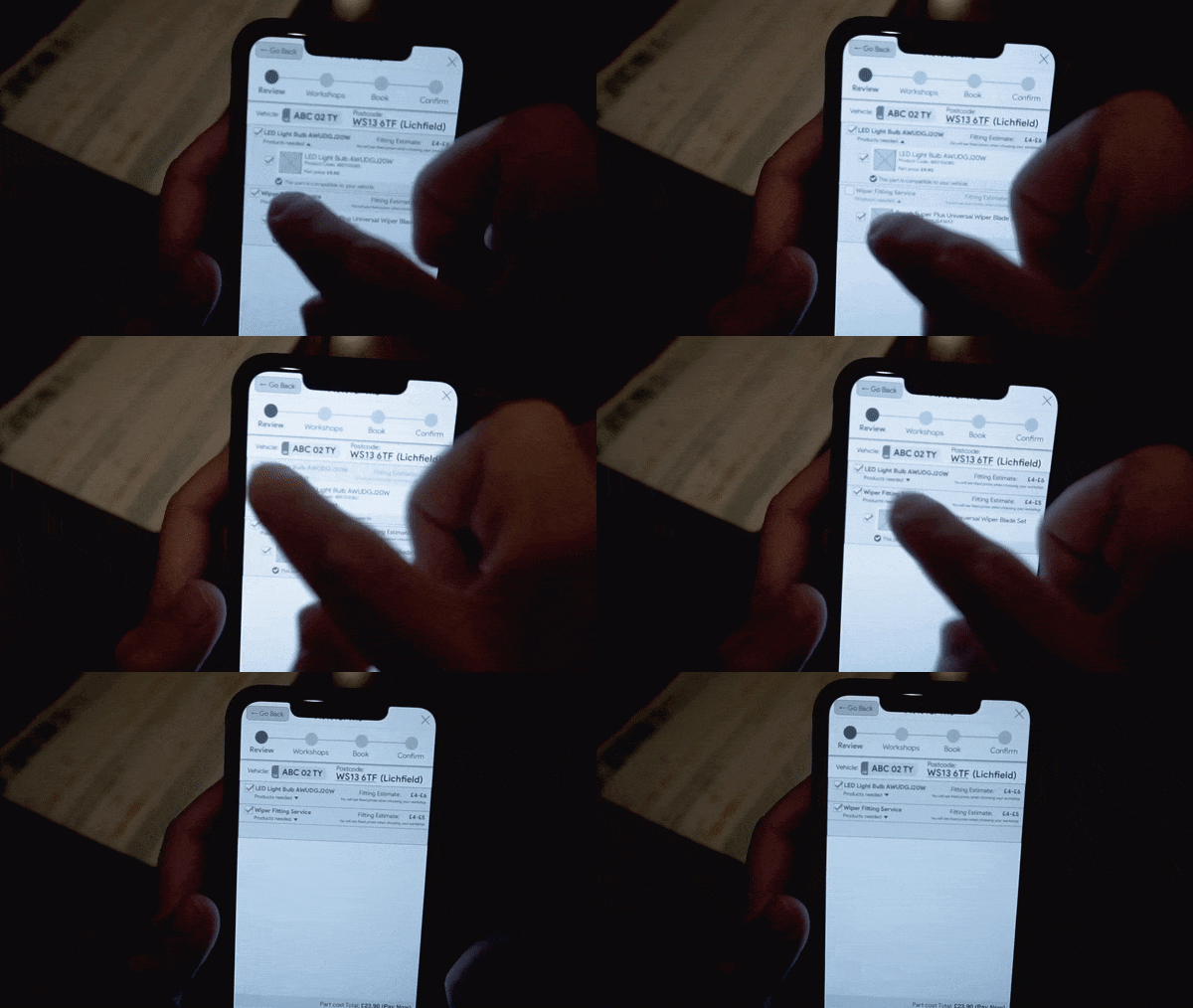
We used Big Light’s internal user testing facility in order to get feedback on our prototype model.
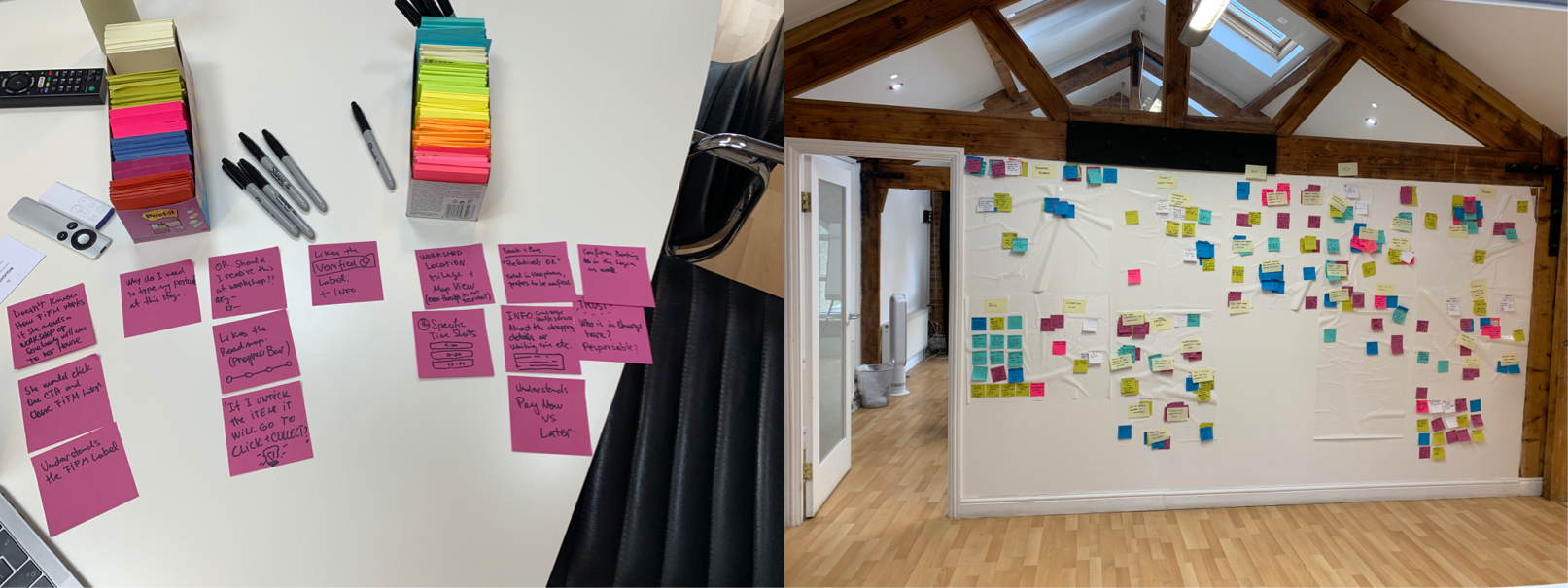
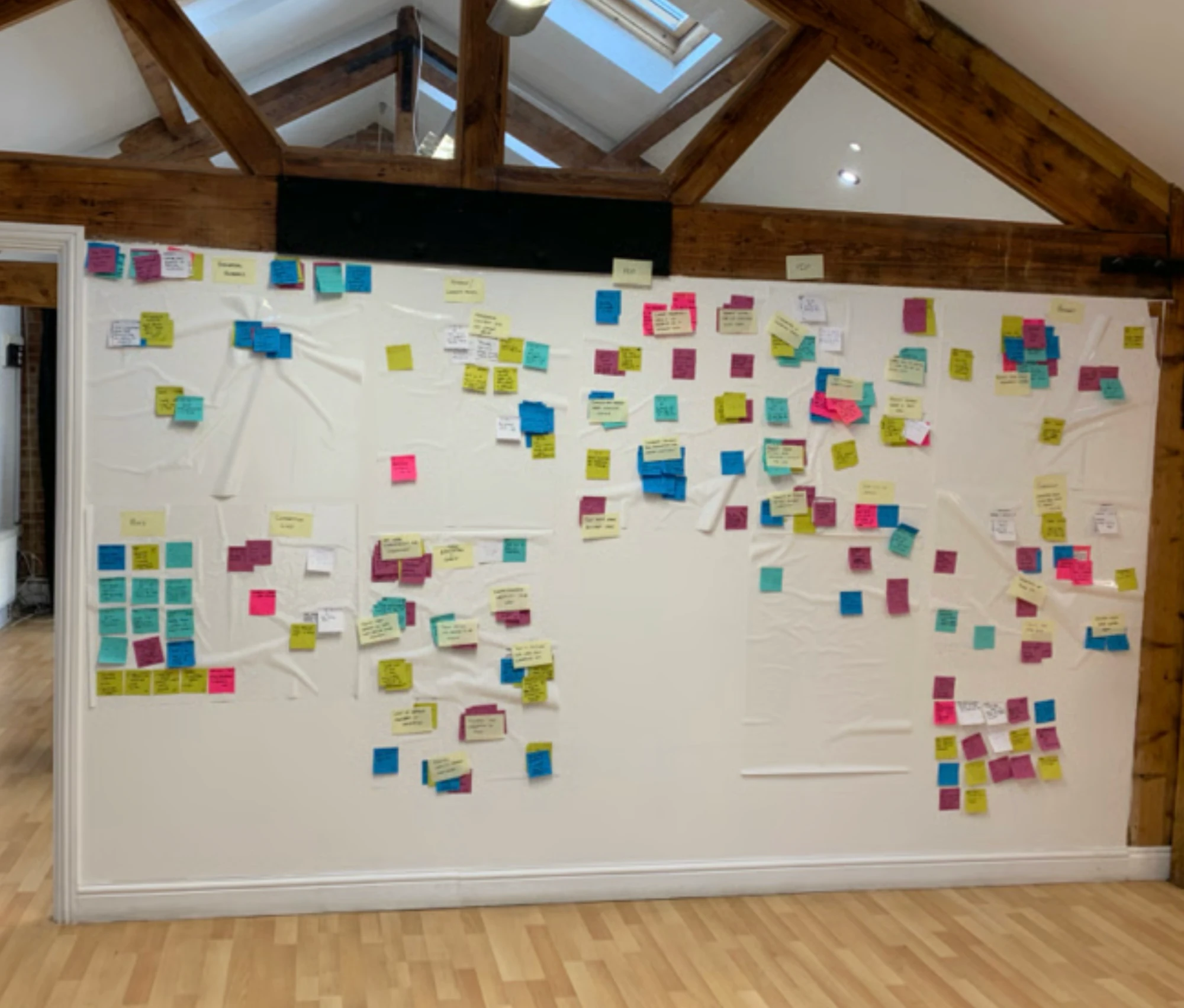
We added our feedback to post-it notes colour-coded for each user.
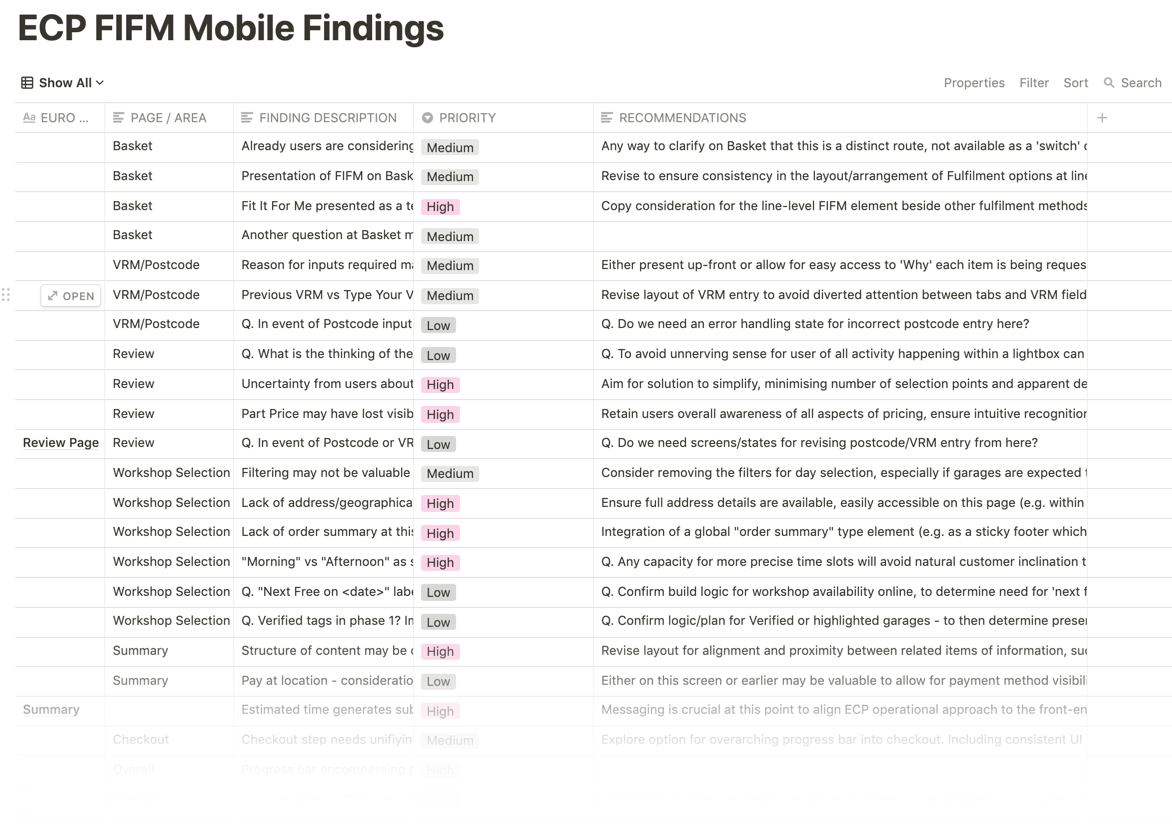
And from here all the data was transferred to a spreadsheet format and prioritised.
12 — ResponsiveDesktop Version
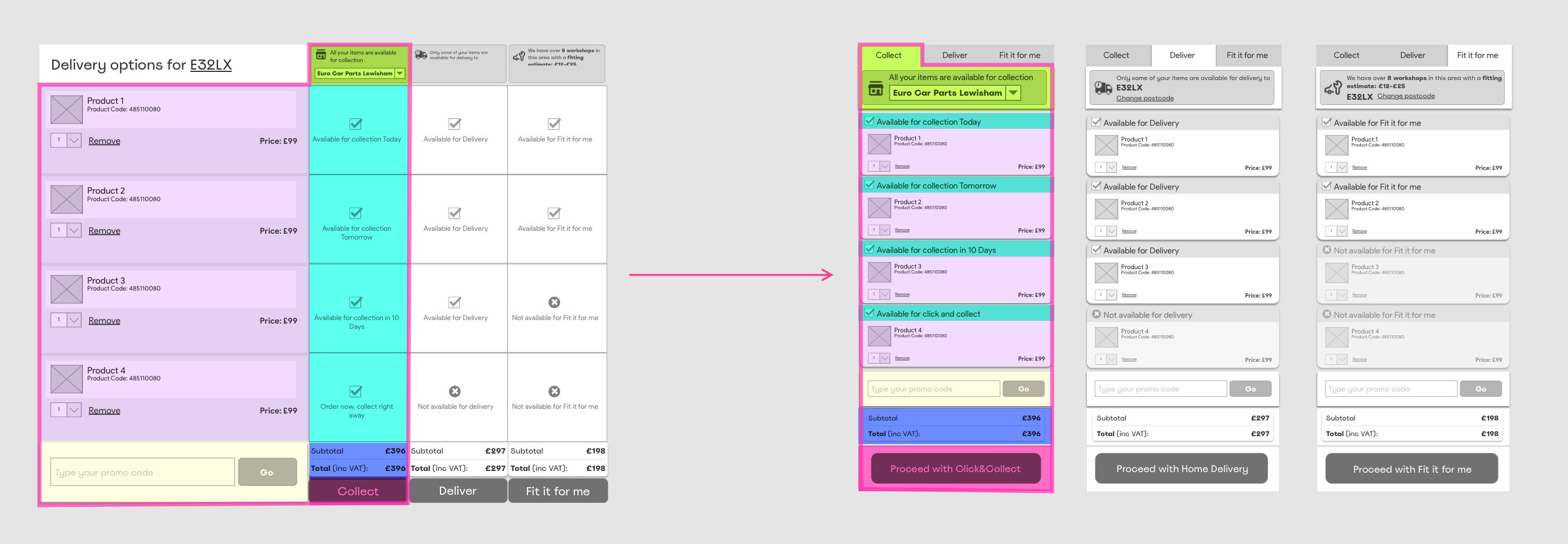
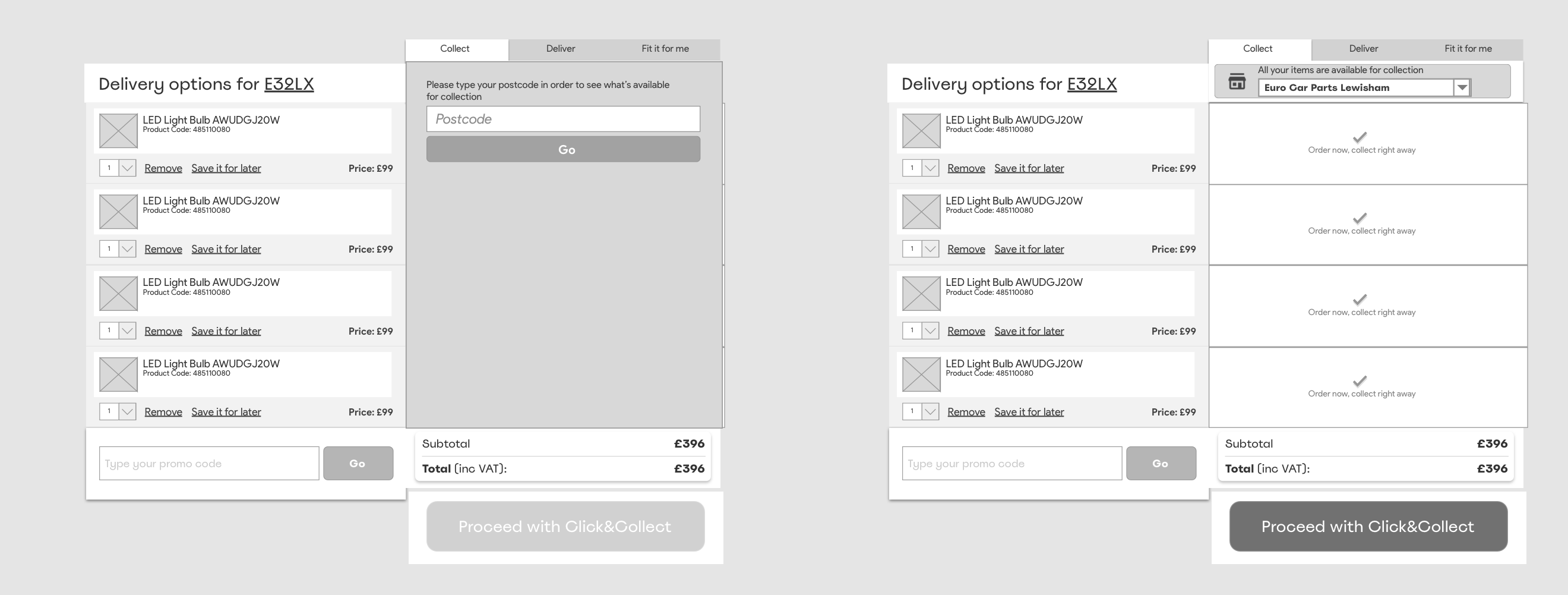
As 70% of the traffic on eurocarparts.com is from smartphones it made sense to start on mobile and then translate it to desktop. The logic of desktop is to keep the same elements from mobile and think how the extra space can be used in order to show more details — such as things that on mobile require an extra tap for example.
13 — PricingPrice Preview
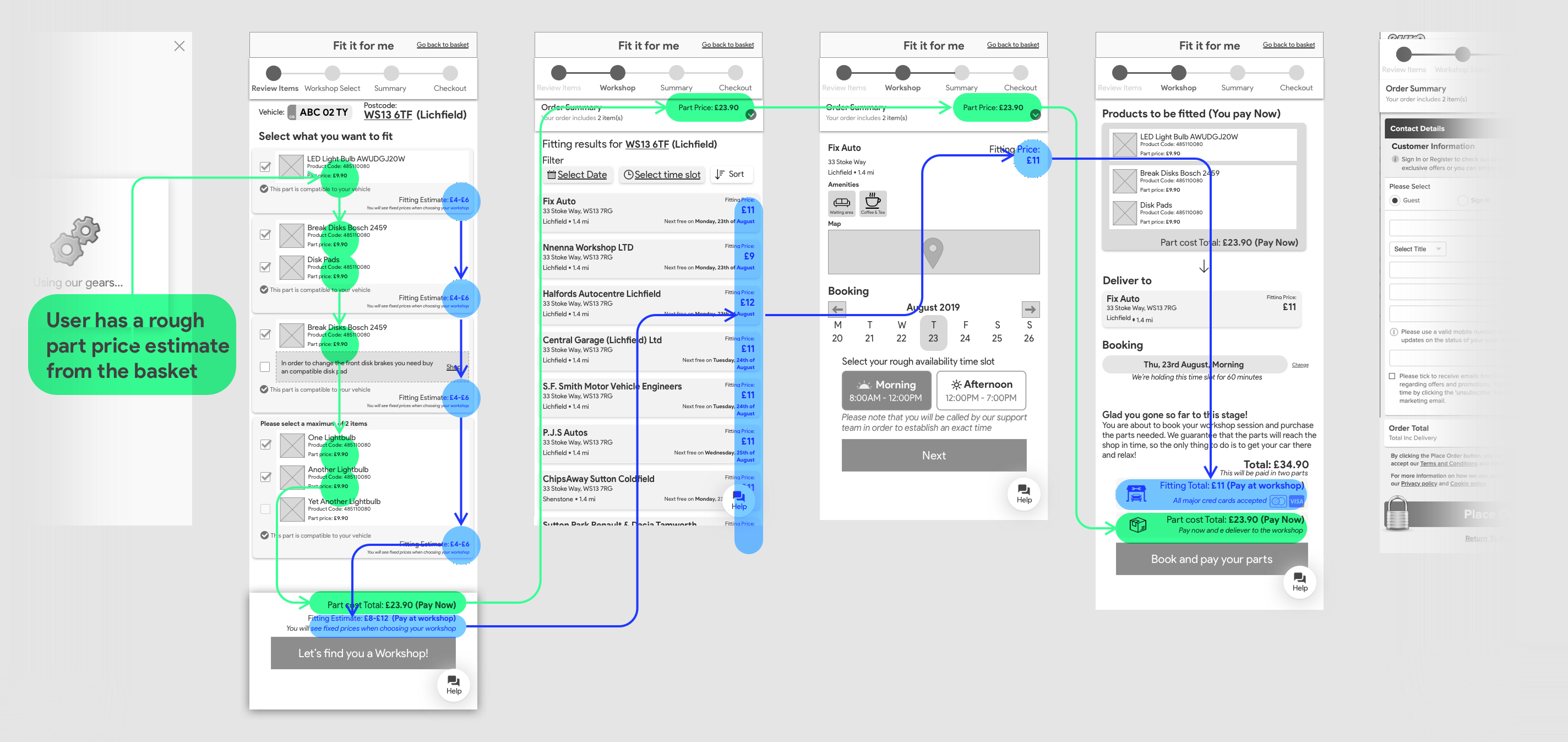
One of the things that came out of our testing is that users need to always have the price and order summary in sight. So throughout the journey we created a fixed drawer on the top that in the initial position will show items and price.
14 — UIVisual Design
In order to speed up the design process, I’ve created a modular system starting from wireframes. For that we used Sketch components, so every wireframe is, in fact, a group of modular components that I can easily interchange in order to create each user journey.
When we moved to the visual design side of things we gradually skinned the wireframes from the small items like buttons, text blocks, checkboxes, etc and after that we integrated in the breakout points of the design.
15 — StatusConclusions
Currently ECP is implementing the ‘Fit it for me’ service for a selected group of customers in the Midlands, followed shortly by a nationwide rollout throughout the UK.
Products are getting tailored to the user and the aim in the long run is to approach all the user types rather than focusing exclusively on one market.
The products will continue to branch out tailored journeys while keeping the whole checkout process as automatic and minimal as possible.
16 — In the pressPress coverage
Fit It For Me went on to become a real revenue channel for the independent aftermarket — here’s a little of the trade coverage it picked up after launch.
CreditsKudos to Big Light and the Eurocarparts team!
This wouldn’t have been possible without the help of Steve Borges (founder), Anthony Cousin, Will Kettle, Sophie Robson, Manraaj Bansal, Waqaas Sadiq and the awesome team at Eurocarparts.
If you’d like to hear more about this project or to talk about how I can help you grow your start-up, ping me at felix.hornoiu@gmail.com
Related projects
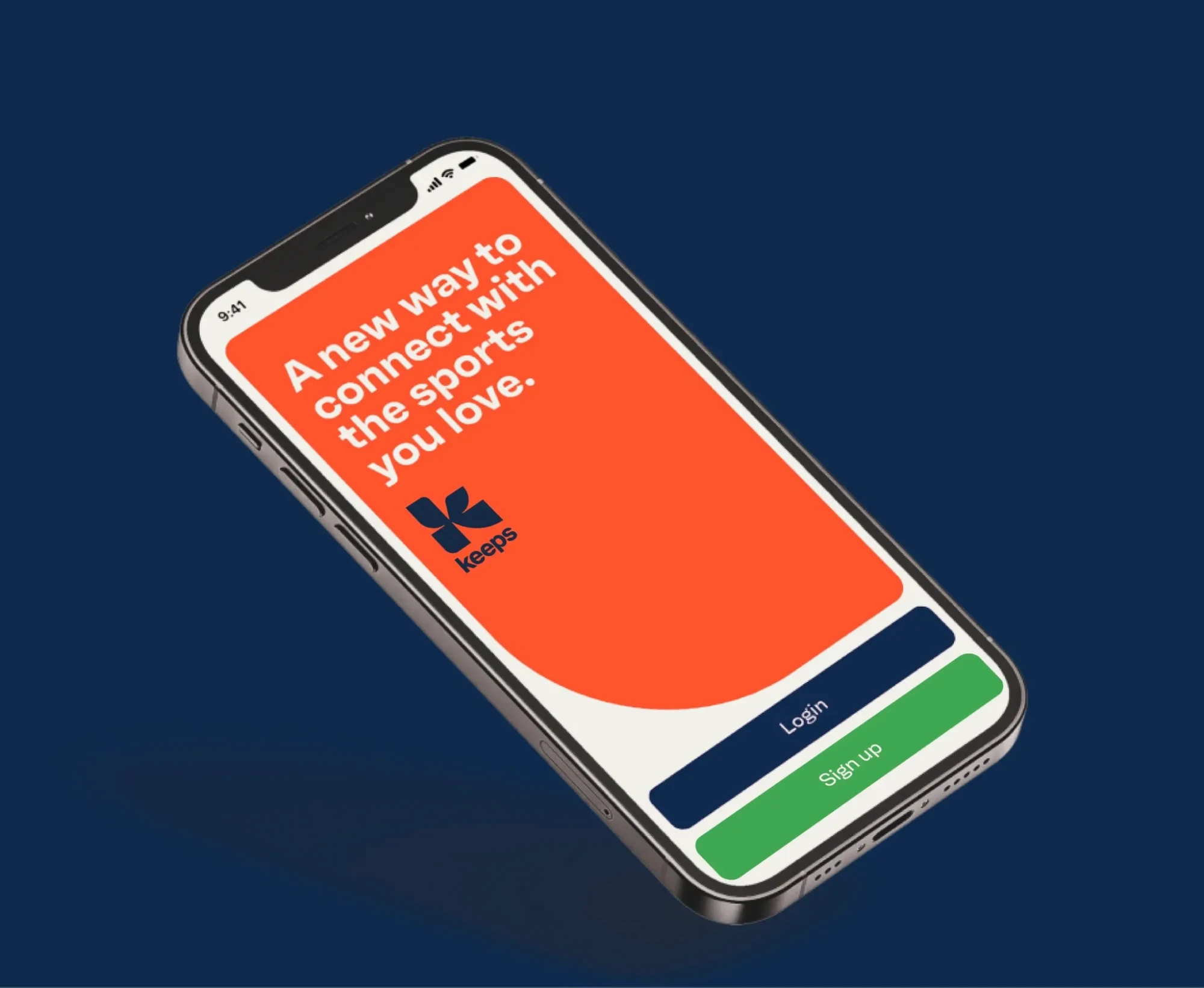
Sport-Investment Platform
UX and a scalable design system for buying, trading and cashing out stakes in sport.
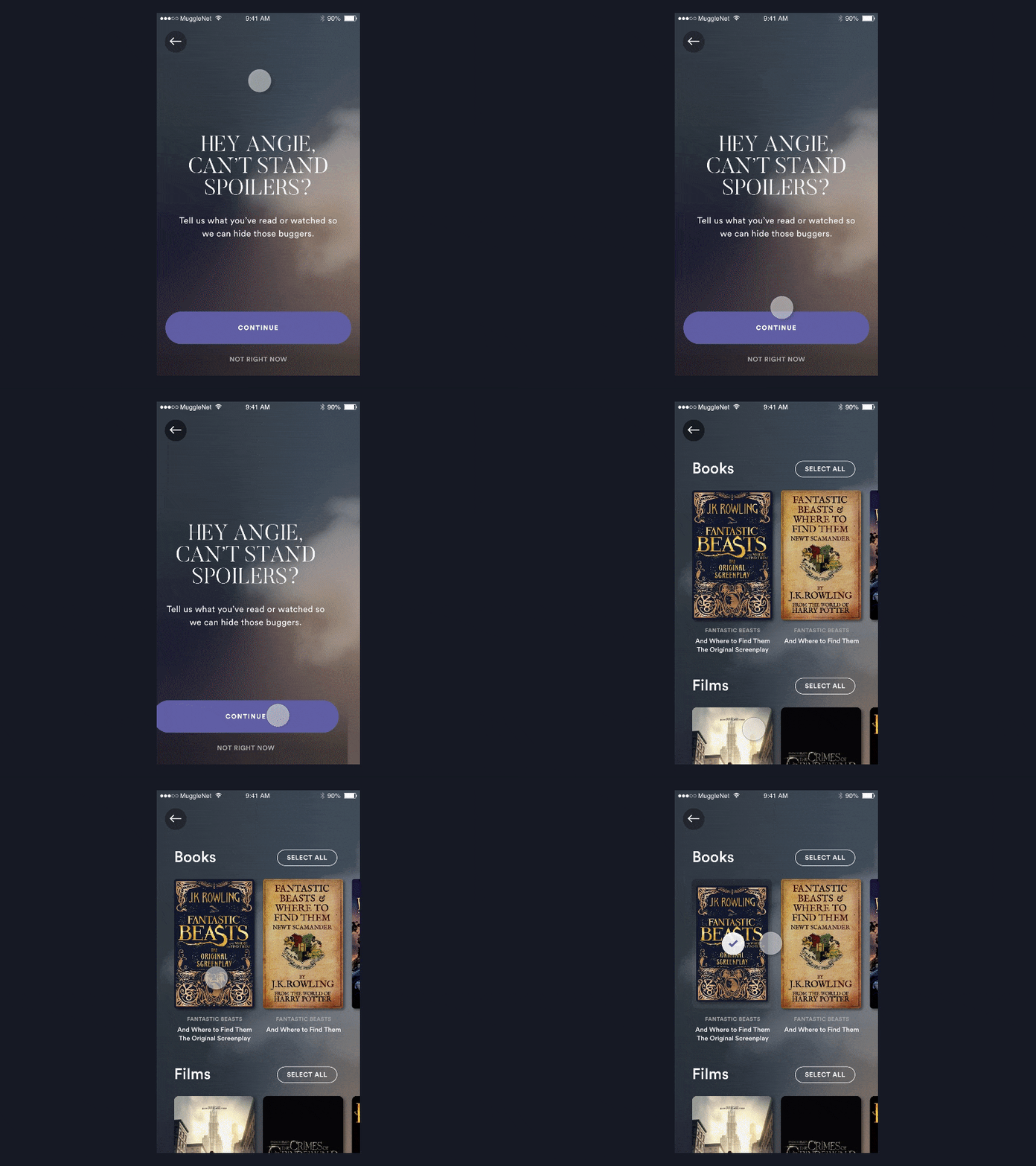
The Wizarding World App
Unifying the Harry Potter universe into one companion app — films, games, quizzes and trailers.
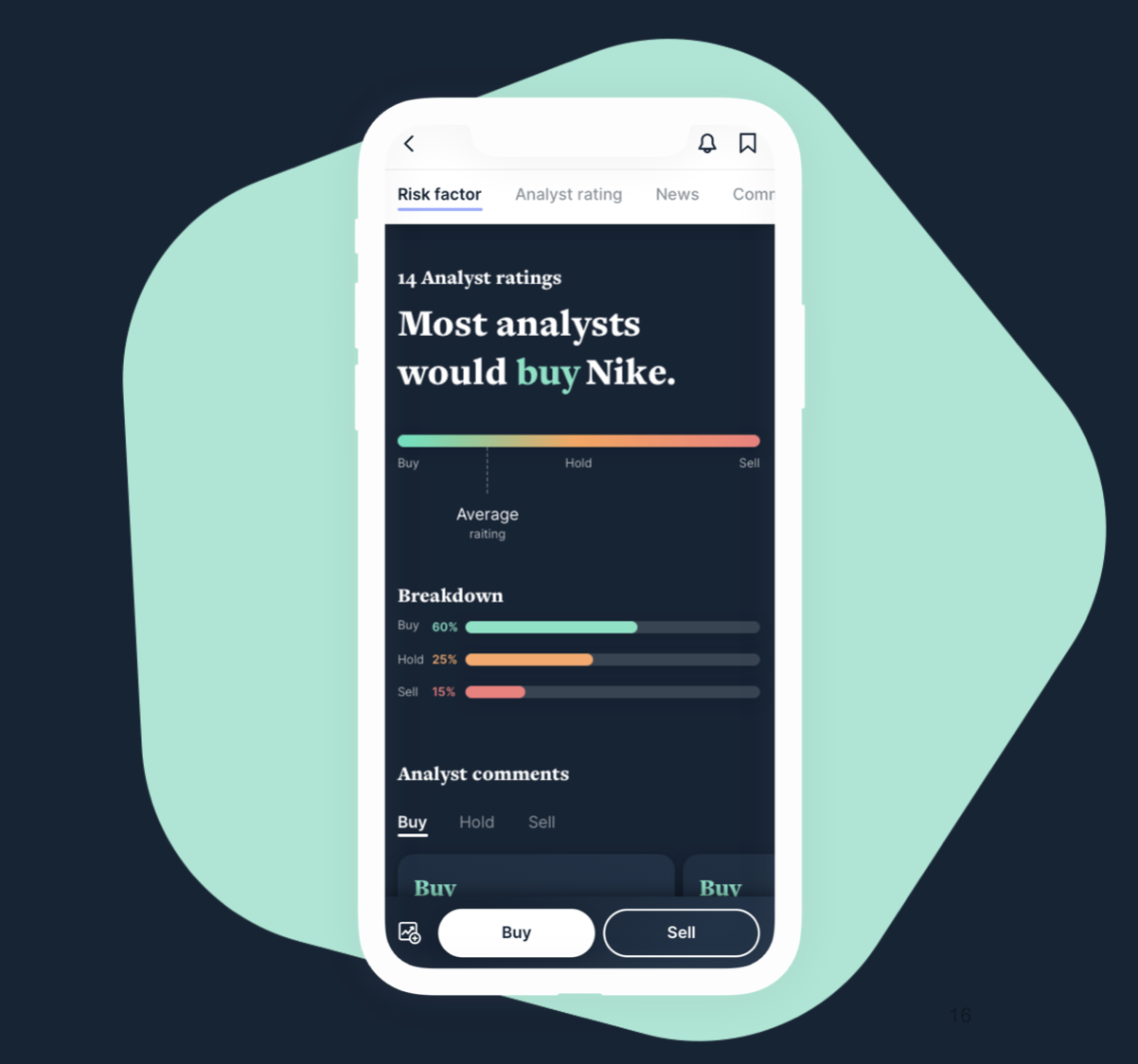
Future of Trading
Layering trading and wealth management onto Citi’s banking app — stocks, crypto, portfolios and advice.
EssilorLuxottica
Reworked checkout and account flows, localised across seven European markets.